Access Restricted
Your access to this website is restricted.
Our website and services are not available to, and are not intended for, individuals who are citizens or residents of the United States, or entities incorporated in or conducting business within the United States.
If this does not apply to you and you believe you have received this message in error, please contact us at [email protected] for further assistance.
If you fall into any of the above categories, please exit the site.
Important Information
Thank you for visiting the Vantage Markets website. Please note that this website is intended for individuals residing in jurisdictions where accessing it is permitted by Vantage and its affiliated entities do not operate in your home jurisdiction.
By clicking 'I CONFIRM MY INTENTION TO PROCEED AND ENTER THIS WEBSITE', you confirm that you are entering this website solely based on your initiative and not as a result of any specific marketing outreach. You wish to obtain information from this website based on reverse solicitation principles, in accordance with the applicable laws of your home jurisdiction.
I CONFIRM MY INTENTION TO PROCEED AND ENTER THIS WEBSITEen

Language
SEARCH
-
AllTradingPlatformsAcademyAnalysisPromotionsAbout
-
Search query too short. Please enter a full word or phrase.
-
Keywords
- Forex Trading
- Vantage Rewards
- Trading Fees
Popular Search
- Trading Accounts
- MT4
- MT5
- TradingView
- Promotions
Reasons to Trade Indices
Indices are benchmarks that are used to gauge the performance of a specific market segment. Some examples include blue-chip stocks, major industrials, or sectors such as tech or healthcare. There are also indices for bonds, commodities and cryptocurrency, as well as for geographical regions or economy types.
An index is calculated based on the individual prices of qualifying securities. Most often, a weighted average calculation method is used, with price-weighted and market capitalisation-weighted indices being among the most common.
In a price-weighted index, securities with a higher price are given more weight in the index, which means they have a greater influence on the index.
Meanwhile, in a market capitalisation-weighted index, companies with larger market capitalisation (share price multiplied by number of outstanding shares) have greater influence on the index.
As you can see, due to the way indices are calculated, their levels go up or down in accordance with the change in prices in the securities being tracked. Furthermore, indices are composed according to precise qualifying characteristics, and index components are regularly evaluated to ensure the integrity of the index. In combination, these factors render indices excellent tools in gauging the overall performance of a given market segment.
Take for instance, the popular S&P 500 index, which measures the performance of the biggest 500 companies listed in the United States. It is weighted by market capitalisation, and constituents that fail to qualify for the index will be removed and replaced by other stocks.
Thus, the S&P 500 is commonly referenced when discussing the performance of the U.S. economy, along with other major benchmarks such as the Dow Jones Industrial Index, and the tech-heavy Nasdaq. Volatility in these three indices reflects ongoing economic turmoil in the US, and prolonged declines are often taken as a sign of a recession.
Now that you understand how indices work and their importance, let’s discuss some reasons for trading them.
Indices Trading Have More Consistent Trends
Comparatively speaking, indices tend to display more consistent price trends, due to the way they are measured.
Recall that in a market capitalisation-weighted index, the largest companies have the greatest sway over the index. This means that if smaller companies in the index are experiencing stock price declines, but the larger ones remain on an uptrend, the index is likely to remain unaffected and continue its prevailing trend.
Thus, trading an index allows traders to screen out market noise from smaller sources with limited impact. They need only focus on important trends and movements, which are reflected in the index in real time.
Indices Trading Pose Lower Risk Than Picking Individual Stocks
As explained, a market index moves when the prices of its component stocks change. The degree of change is dependent on how the index is weighted. But in simple terms, an index can be understood as the average of several prices, instead of one individual price.
In other words, the price movements of indices are moderated across multiple different stocks. This means index price movements may be more moderate than individual stocks, though all trading still carries risk.
While it is true that an individual stock may experience greater price swings than an index. This means it can outperform during certain market phases but also pose higher risk during downturns.
Trading Indices Offer Diversification
Because indices track pre-selected stocks or assets, traders can use them for portfolio diversification.
Indices are structured to capture performance from specific segments of the market; the S&P 500 is essentially a shortcut to many US blue-chip companies, for instance. With the broad range of indices available–from broad market indices to micro-cap stocks–traders can pick from a deep selection of pre-defined market segments.
This means that some traders use indices CFDs to gain broader market exposure or diversify across sectors, though this does not eliminate risk. This approach is often used by traders to gain broader market exposure and reduce concentration in specific segments, though it does not eliminate risk.
Why Trade Indices Using Contracts for Difference (CFDs)?
Strictly speaking, indices cannot be traded, as they are simply a measurement of a certain market segment. To trade an index, you will need to use an indirect or proxy method, such as an index fund (an investment fund that tracks the performance of an index).
Alternatively, you can use a financial derivative such as CFDs to trade the price action of your chosen index.
A CFD is a contract to exchange the difference in price in an underlying asset (or index, in this case) between the start of the contract and the closing of the contract. There is no other connection or involvement, only the price action of the chosen market.
In the case of indices their readings, updated in real time, are referenced in a CFD trade. Depending on whether the index moved with or against the trader’s position from the time it was opened to the time it was closed, a profit or loss is made.
There are many beneficial reasons to trade indices using CFDs, but now, let’s zoom into two of the most compelling ones.
Contracts for Difference (CFDs) Let You Trade Indices Using Leverage
CFDs allow you to trade indices using leverage, which can be a game changer in your trading–provided you take the necessary precautions.
Leverage allows you to open a position with a smaller initial deposit. While this can increase exposure, it also amplifies potential losses and requires strict risk management.
If the trade plays out in your favour, your return rate would be amplified, as you would have made a profit on a smaller capital. However, leverage amplifies losses too, and high leverage or the market moving sharly against your position can result in losses exceeding the deposit amount, putting your account into the red.
To manage risks, brokers may put out a margin call on leveraged trades that are in a losing position. This means topping up additional funds to meet the maintenance margin (this is the minimum amount of funds required to continue holding your CFD position) within a stipulated grace period.
Failing to meet the margin call will cause your broker to close your position immediately and assign any arising losses to your account.
Leverage can increase capital efficiency, but it also raises the risk of amplified losses. Traders should understand both the advantages and risks before applying it. It must also be used with caution and skill; if your bet turns out wrong, leverage can deepen losses.
Contracts for Difference (CFDs) Let You Trade Indices Going Long or Short
When trading indices using an index fund or ETF, you will only make a profit if you manage to sell your holdings at a higher index level than the one at which you bought them. This requires the index to go up; if it goes down, you will make a loss if you sell.
With CFDs, this limitation is lifted. When trading index CFDs, you can choose to take a long position to profit when the index goes up, or a short position to profit when the index goes down.
CFDs allow you to trade both rising and falling markets, but this flexibility still involves substantial risk if the market moves against your position.
To support decision-making as they trade indices, traders commonly utilise technical analysis, relying on indicators and charting tools to measure the likelihood of a price trend based on past price action.
CFDs offer the possibility to trade in either direction, but success depends on market conditions, analysis, and risk management.
Advantages of Trading Indices
Trading indices can offer many advantages, including some not found when trading other assets.
1. Simplicity in trade selection
Indices provide exposure to pre-defined market segments, saving traders from having to sort, filter and select their own list of stocks. Index readings also provide credible guidance on which way the market is going at a glance. As such, those who trade indices can benefit from simpler trading selection and a less complicated trading decision process.
2. Cost efficiency
Trading indices can be more cost effective than trading several individual stocks. Instead of having to purchase and trade several different stocks individually–causing trading fees to add up–a trader can trade several stocks at once via an index, avoiding multiple fees.
Additionally, many brokerages offer tight spreads when trading index CFDs–this further lowers trading costs and improves cost efficiency.
3. Sector specific exposure
Indices offer sector-specific exposure that helps traders zoom in on the exact market segments they want to trade. This saves traders from spending time screening out specific stocks.
Another advantage: Trading indices that are inversely correlated can be a good way to hedge against risk–losses in one index may be offset by gains in another.
4. Broad-market exposure
While some indices are made to zoom in on specific market segments, others are designed to facilitate wider market exposure. This allows traders to trade the performance of leading economies such as the US and China, but also wider geographical regions such as Asia or Latin America.
How to Trade Indices via CFDs with Vantage
Interested to begin trading index CFDs with Vantage? Here’s a simple step-by-step guide on how to get started:
Sign up and open a live trading account with Vantage. Our platform offers seamless access to a wide variety of indices, competitive pricing, and powerful tools to support your trades. Decide which indices you want to trade via CFDs. Vantage offers access to a wide range of global indices, including the S&P 500, NASDAQ-100, and FTSE 100. Select the indices that match your trading preferences or market outlook. Before placing any trades, it’s crucial to analyse the index markets. Take advantage of Vantage’s tools and resources to study market trends, economic indicators, and other relevant data. This analysis can help you make more informed trading decisions. When you’re ready, place your index CFD trade directly through our intuitive platforms, including MT4, MT5, or the Vantage App. Stay in control of your trades with Vantage’s suite of tools. Track the performance of your index positions and adjust your approach as needed to stay aligned with your trading goals.
Open a Live Account
Choose Your Indices
Analyse the Markets
Execute Your Trade
Monitor and Optimise Your Portfolio
Explore More About Indices Trading
-
What are Indices
Learn what indices are, how they work, and their importance in financial markets and trading.
-
How to Trade Indices
Find out how to trade indices with CFDs, and the advantages trading indices can offer.
-
Indices Trading Strategies
Explore popular strategies for indices trading, ranging from trend following and breakout trading to hedging and sector rotation.

Award-Winning Broker
-
Most Innovative
BrokerFX Broker Tester
-
Best CFD
BrokerGlobal Brands Magazine
-
Best APAC
Region BrokerADVFN International Financial Awards

Trade Indices CFDS On Different Types Of Trading Platforms
MetaTrader 4
- 30 Built-in technical indicators
- 31 Analytical Charting Tools
- 9 Time-Frames
- 4 Types of trading orders
MetaTrader 5
- 38 Built-in technical indicators
- 44 Analytical Charting Tools
- 21 Time-Frames
- 6 Types of trading orders
TradingView
- 15+ chart types
- 100+ in-built indicators
- 50+ Drawing tools
- 12 alert conditions
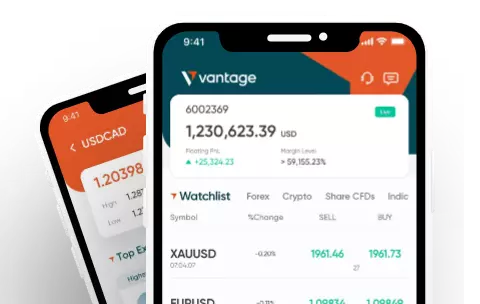
Vantage Mobile App
- 55 Deposit Methods Globally
- 220+ Daily Product Analysis
- 16 TradingView Indicators
- 80,000+ Copy Traders
Choose a Trading Account Based on Your Experience Level
-
1
Any level
-
2
Beginner Traders
For beginner traders looking for direct market access with no commissions.
- Tight spreads from 1.1 pip.
- No extra commissions on trading volume.
-
3
Experience Traders
Offering seasoned traders razor-sharp spreads, low commissions, and deep liquidity.
- Tight spreads from 0.0 pip.
- Commisssions from USD$3.00 per standard lot, per side.
-
4
Professional Traders
For professional traders and money managers who trade large volumes.
- Tights spreads from 0.0 pip.
- Commissions from USD$1.50 per standard lot, per side.
-
1
Register
Quick and easy account opening process.
-
2
Fund
Fund your trading account with an extensive choice of deposit methods.
-
3
Trade
Trade with spreads starting as low as 0.0 and gain access to over 1,000+ CFD Instruments.
RISK WARNING: CFDs are complex financial instruments and carry a high risk of losing money rapidly due to leverage. You should ensure you fully understand the risks involved and carefully consider whether you can afford to take the high risk of losing your money before trading.
Disclaimer: The information is provided for educational purposes only and doesn't take into account your personal objectives, financial circumstances, or needs. It does not constitute investment advice. We encourage you to seek independent advice if necessary. The information has not been prepared in accordance with legal requirements designed to promote the independence of investment research. No representation or warranty is given as to the accuracy or completeness of any information contained within. This material may contain historical or past performance figures and should not be relied on. Furthermore estimates, forward-looking statements, and forecasts cannot be guaranteed. The information on this site and the products and services offered are not intended for distribution to any person in any country or jurisdiction where such distribution or use would be contrary to local law or regulation.