


 Updated
Stock market trading hours are the fixed windows when an exchange accepts orders to buy and sell shares — and they run as a global relay rather than on a single clock. As the closing bell sounds in New York, London has already wrapped up for the day and Tokyo is preparing for the next session. Every exchange keeps its own schedule, set by its local time zone, regulator, and market conventions.
That staggered structure means at almost any hour at least one major market is open somewhere. Knowing when each exchange opens and closes — and how those times translate into your own time zone — helps you follow price action when a market is most active, and avoid sending orders into a closed or thinly traded session.
Key Points
- Most stock exchanges trade for six to eight hours on weekdays only, but their opening times are staggered across time zones, so the global market is rarely closed entirely at any single moment.
- For equity traders, the deepest liquidity usually falls in the London–New York overlap, roughly 14:30 to 16:30 GMT, when two of the world’s largest markets are open at the same time.
- US exchanges are moving toward far longer sessions: in April 2026 the SEC approved a 23-hour trading day for Nasdaq, following similar approvals for NYSE Arca and the new 24X exchange.
What Time Does the Stock Market Open and Close?
There is no single answer, because it depends on the exchange. In the United States, the New York Stock Exchange (NYSE) and Nasdaq run their regular session from 09:30 to 16:00 Eastern Time (14:30 to 21:00 GMT), Monday to Friday. The London Stock Exchange (LSE) trades from 08:00 to 16:30 GMT, and the Tokyo Stock Exchange (TSE) from 09:00 to 15:30 Japan Standard Time (00:00 to 06:30 GMT), with a midday break.
The Tokyo close is more recent than many references suggest. The TSE extended its trading day by 30 minutes to 15:30 on 5 November 2024, adding a five-minute closing auction from 15:25, according to the Japan Exchange Group [1].
Most exchanges share a broadly similar shape — a morning open, a continuous session of six to eight hours, and an afternoon close — but the exact times, lunch breaks, and auction periods differ. The full breakdown by exchange follows below.
Stock Market Trading Hours by Exchange
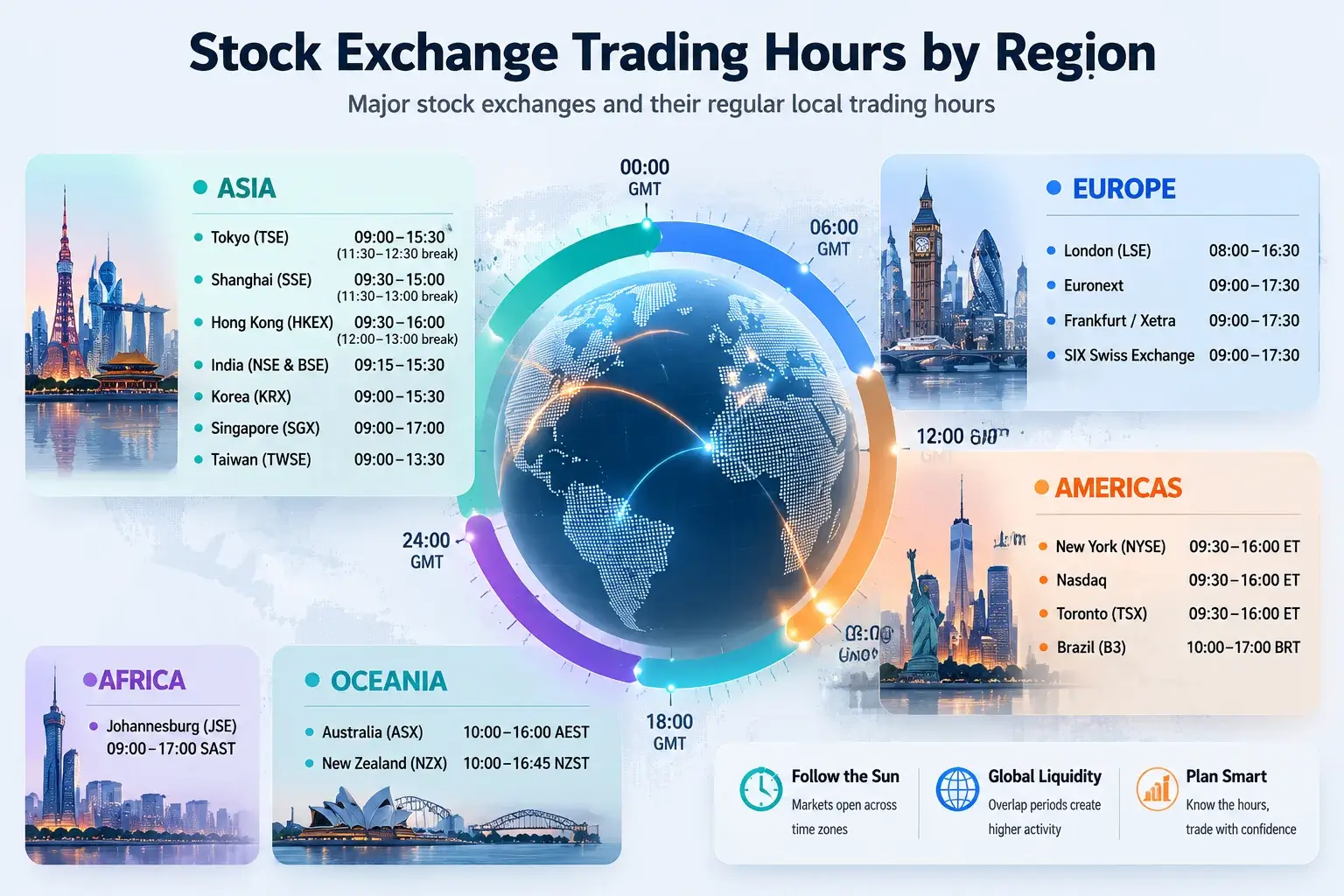
The table below lists the regular cash-session hours for some of the world’s largest stock exchanges in both local time and GMT. The GMT times are approximate: they shift by an hour whenever a market observes daylight saving, so treat them as a guide rather than a fixed schedule.
| Stock Exchange | Region | Local Trading Hours | GMT (approx.) |
| Tokyo Stock Exchange (TSE) | Asia | 09:00–11:30, 12:30–15:30 | 00:00–06:30 |
| Shanghai Stock Exchange (SSE) | Asia | 09:30–11:30, 13:00–15:00 | 01:30–07:00 |
| Hong Kong Exchange (HKEX) | Asia | 09:30–12:00, 13:00–16:00 | 01:30–08:00 |
| National Stock Exchange of India (NSE) | Asia | 09:15–15:30 | 03:45–10:00 |
| Bombay Stock Exchange (BSE) | Asia | 09:15–15:30 | 03:45–10:00 |
| Korea Exchange (KRX) | Asia | 09:00–15:30 | 00:00–06:30 |
| Singapore Exchange (SGX) | Asia | 09:00–17:00 | 01:00–09:00 |
| Taiwan Stock Exchange (TWSE) | Asia | 09:00–13:30 | 01:00–05:30 |
| London Stock Exchange (LSE) | Europe | 08:00–16:30 | 08:00–16:30 |
| Euronext | Europe | 09:00–17:30 CET | 08:00–16:30 |
| Frankfurt / Xetra (FSX) | Europe | 09:00–17:30 CET | 08:00–16:30 |
| SIX Swiss Exchange | Europe | 09:00–17:30 CET | 08:00–16:30 |
| New York Stock Exchange (NYSE) | Americas | 09:30–16:00 ET | 14:30–21:00 |
| Nasdaq | Americas | 09:30–16:00 ET | 14:30–21:00 |
| Toronto Stock Exchange (TSX) | Americas | 09:30–16:00 ET | 14:30–21:00 |
| B3 (Brazil) | Americas | 10:00–17:00 BRT | 13:00–20:00 |
| Johannesburg Stock Exchange (JSE) | Africa | 09:00–17:00 SAST | 07:00–15:00 |
| Australian Securities Exchange (ASX) | Oceania | 10:00–16:00 AEST | 00:00–06:00 |
| New Zealand Exchange (NZX) | Oceania | 10:00–16:45 NZST | 21:00–03:45 |
A few regional patterns stand out. Many Asian markets, including Tokyo and Shanghai, pause for a midday lunch break — a convention rarely seen in Europe or the Americas. European exchanges such as the LSE trade continuously but frame the day with opening and closing auctions that help set reference prices. Because Sydney and Auckland sit furthest east, the ASX and NZX are usually the first major venues to open each weekday, setting early sentiment before Tokyo, where the Nikkei 225 trades, comes online.
Converting Stock Market Hours Across Time Zones
The hardest part of tracking global markets is often not the local hours themselves but converting them, because several major financial centres change their clocks twice a year, and not on the same dates.
US hours are quoted in Eastern Time, which is Eastern Standard Time (EST, GMT−5) in winter and Eastern Daylight Time (EDT, GMT−4) in summer. London moves between GMT and British Summer Time (BST, GMT+1), and continental Europe shifts between Central European Time and its summer equivalent. Japan does not observe daylight saving, so Tokyo stays fixed at GMT+9 all year — which means the gap between Tokyo and New York actually changes with the seasons.
A worked example makes the effect clear. For a trader in the Philippines (GMT+8), the 09:30 ET opening bell in New York lands at 21:30 local time during US summer and 22:30 during US winter. In India (GMT+5:30), the same open falls at either 19:00 or 20:00.
The practical takeaway is to treat each exchange’s local time as the fixed reference, then convert — and re-check during the two- to three-week windows in spring and autumn when regions switch on different dates. Equity sessions also differ from the forex market, which runs on a near-continuous 24-hour, five-day schedule.
When Global Stock Markets Overlap
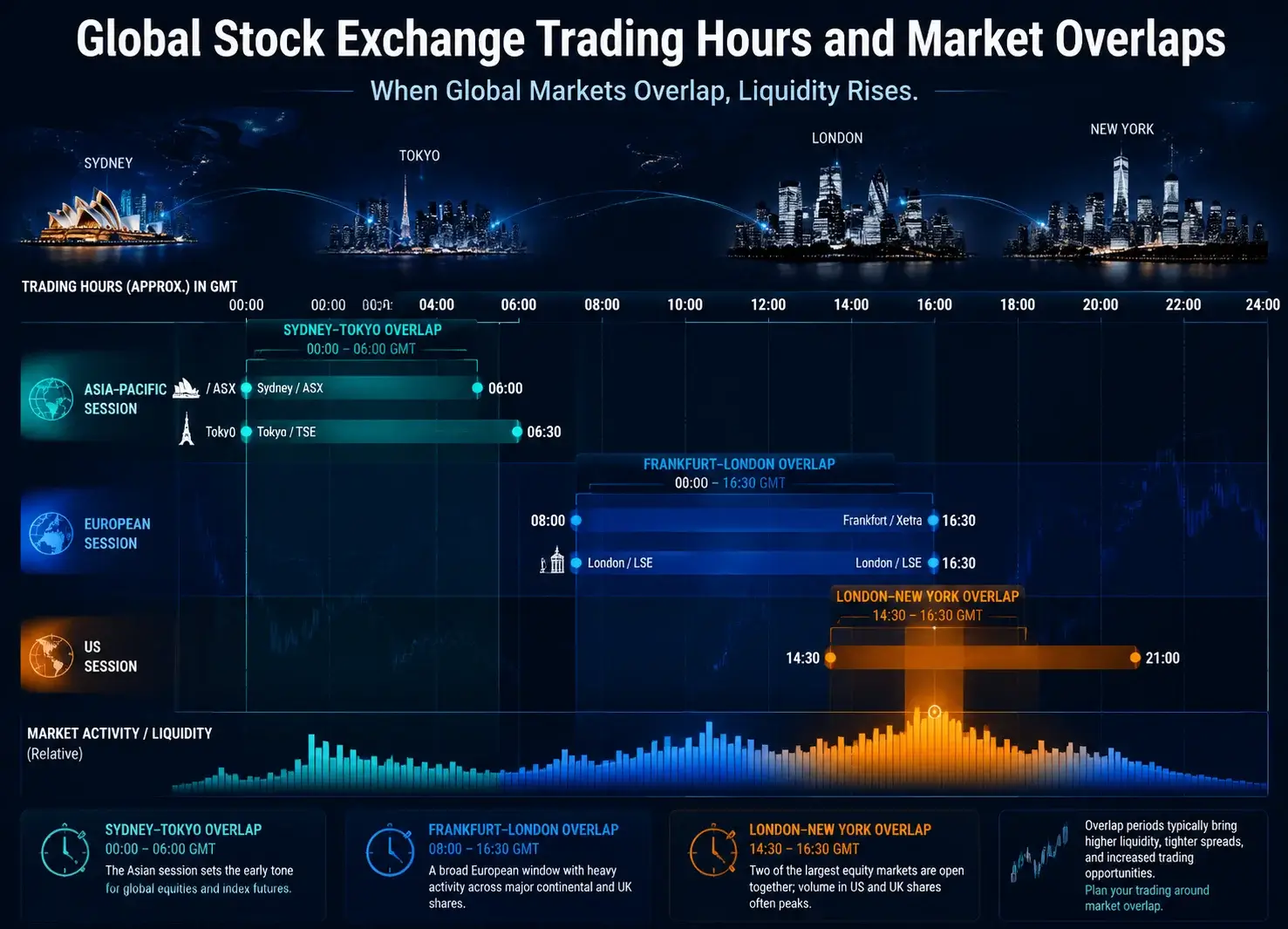
When two large markets are open at the same time, more participants are active, which often means higher liquidity and tighter spreads. For equity traders, the overlap that matters most is between London and New York.
| Overlap | Approx. GMT | Why It Matters |
| London–New York | 14:30–16:30 | Two of the largest equity markets are open together; volume in US and UK shares often peaks. |
| Sydney–Tokyo | 00:00–06:00 | The Asian session sets the early tone for global equities and index futures. |
| Frankfurt–London | 08:00–16:30 | A broad European window with heavy activity across major continental and UK shares. |
A related high-activity window is the final hour before the US close, sometimes called the ‘power hour’, from 15:00 to 16:00 ET (20:00 to 21:00 GMT in winter). Institutional investors often adjust positions before the bell, which can lift both volume and volatility.
That heightened activity cuts both ways: faster moves can also mean wider spreads and sharper reversals, so the window that concentrates opportunity concentrates risk too.
Extended-Hours Trading and the Move Toward 23-Hour Sessions
Beyond the regular session, US exchanges have long offered extended-hours trading. On Nasdaq that currently means a pre-market session from 04:00 to 09:30 ET and a post-market session from 16:00 to 20:00 ET, when trading the Nasdaq outside standard hours is possible, though with more limited functionality [2].
These sessions let traders react to earnings and news released outside normal hours. The trade-off is structural: volume is thinner, bid-ask spreads are wider, and prices can move sharply on relatively small orders, so extended-hours activity tends to suit more experienced traders who understand those conditions.
The bigger shift is toward near round-the-clock trading. On 10 April 2026, the US Securities and Exchange Commission approved Nasdaq’s plan to extend equity trading to 23 hours a day, five days a week, with the change expected to take effect in the second half of 2026 [3].
The SEC had already cleared a 22-hour session for NYSE Arca in early 2025 and registered the new 24X exchange for a 23-hour day [3]. The one-hour daily pause is reserved for maintenance and processing corporate actions such as dividends and stock splits.
If these sessions launch as planned, the practical line between ‘regular’ and ‘extended’ hours may blur for US-listed shares. Regulators and exchanges have noted that overnight sessions are likely to carry the same thin-liquidity and wider-spread characteristics as today’s pre- and post-market windows, and that some investor-protection mechanisms which apply during regular hours do not currently extend to them.
Stock Market Holidays and Early Closes
Exchanges close on weekends and on national public holidays, and these calendars do not line up across countries. The London Stock Exchange closes for UK bank holidays such as Christmas and Good Friday; the Tokyo Stock Exchange shuts for Japanese holidays including the New Year period and Golden Week; and US markets close for days such as Independence Day and Thanksgiving.
Around some holidays, exchanges also schedule early closes, ending a session hours earlier than usual. A holiday in one major centre can thin liquidity elsewhere too: when US markets are shut, the London–New York overlap disappears for the day, and volume in globally traded shares during that window is often noticeably lower.
Because holiday dates and early-close schedules change from year to year, the reliable approach is to check the official calendar published by the exchange you are following before planning around a specific date.
How Trading Hours Apply to Share CFDs
Some market participants trade Contracts for Difference (CFDs), which track the price movements of underlying shares without conveying ownership of those shares. A share CFD’s tradeable window generally mirrors the underlying exchange’s session: a CFD on a US-listed company typically follows the NYSE or Nasdaq cash session (09:30–16:00 ET), while a CFD on a London-listed company tracks the LSE’s 08:00–16:30 GMT hours.
Availability for share CFD trading follows the relevant exchange session, while index CFDs — which track a basket such as the FTSE 100 or Nasdaq 100 — may be available across a longer window that can extend beyond the cash session. Availability of CFD products varies by jurisdiction and may be subject to local regulation. Other markets keep entirely different schedules; the gold market, for example, trades on a near-24-hour cycle, unlike equities.
Trading around session opens, closes, and overlaps can mean more price movement, but CFDs are leveraged products: leverage can magnify both gains and losses, and the thinner liquidity outside regular hours can widen spreads and increase the risk of slippage.
Checking the specific trading hours for each instrument on your platform, rather than assuming they match the underlying exchange exactly, helps avoid placing an order when a market is closed or only lightly traded.
Aligning Your Trading With Global Market Hours
Global stock market hours form a near-continuous relay. As Sydney and Tokyo wind down, Europe opens, and by early afternoon GMT the London–New York overlap brings the day’s deepest liquidity. For anyone following equities, the useful skill is not memorising every timetable but knowing which session is active when you are at your screen, and how that translates into your own time zone.
Vantage provides access to Share CFDs and index CFDs across a range of global markets. As with any leveraged product, it is important to understand that CFDs carry a high risk of losing money, and that conditions vary considerably between a busy overlap and a thin overnight session.
Frequently Asked Questions
What time does the stock market open?
It depends on the exchange. In the US, the NYSE and Nasdaq open at 09:30 Eastern Time (14:30 GMT); the London Stock Exchange opens at 08:00 GMT; and the Tokyo Stock Exchange opens at 09:00 Japan Standard Time (00:00 GMT). Because each market follows its local time zone, the opening bell falls at a different hour in your own time zone depending on where the exchange sits.
What time does the stock market close?
Closing times also vary by exchange. The NYSE and Nasdaq close at 16:00 Eastern Time (21:00 GMT), the London Stock Exchange at 16:30 GMT, and the Tokyo Stock Exchange at 15:30 Japan Standard Time — extended from 15:00 in November 2024. Some US exchanges are now moving toward much longer sessions, so standard closing times for US-listed shares may change from the second half of 2026.
Which stock market opens first in the world each day?
Among major exchanges, those furthest east open first. The Australian Securities Exchange and New Zealand’s NZX are typically the first large venues to begin trading each weekday, ahead of the Asian session led by Tokyo, Hong Kong, and Shanghai. Their early moves can help set sentiment before Europe and the Americas come online.
How can I tell which stock market is open right now?
The simplest way is to convert the exchange’s local session into your own time zone, remembering that several markets shift with daylight saving at different times of year. A world clock or the exchange’s official website will show its current status, and most trading platforms indicate whether a specific instrument is currently tradeable. During daylight-saving transition weeks it is worth double-checking, as GMT offsets change.
Do all stock markets close for a lunch break?
No. A midday lunch break is common across several Asian exchanges — Tokyo pauses from 11:30 to 12:30 and Shanghai from 11:30 to 13:00, for example — during which no trading takes place. Most European and US exchanges, including the LSE, NYSE, and Nasdaq, trade continuously through the day with no scheduled break.
Are stock market trading hours the same all year round?
The local hours of each exchange usually stay fixed, but the GMT equivalents shift when a market observes daylight saving. US and European markets change their clocks twice a year while Japan does not, so the time difference between them varies by season. Exchanges also close on national public holidays, which differ from country to country, and occasionally run shortened sessions around them.
RISK WARNING: CFDs are complex financial instruments and carry a high risk of losing money rapidly due to leverage. You should ensure you fully understand the risks involved and carefully consider whether you can afford to take the high risk of losing your money before trading.
Disclaimer: The information is provided for educational purposes only and doesn’t take into account your personal objectives, financial circumstances, or needs. It does not constitute investment advice. We encourage you to seek independent advice if necessary. The information has not been prepared in accordance with legal requirements designed to promote the independence of investment research. No representation or warranty is given as to the accuracy or completeness of any information contained within. This material may contain historical or past performance figures and should not be relied on. Furthermore estimates, forward-looking statements, and forecasts cannot be guaranteed. The information on this site and the products and services offered are not intended for distribution to any person in any country or jurisdiction where such distribution or use would be contrary to local law or regulation.
References
- “Trading Hours, Trading Rules of Domestic Stocks – Japan Exchange Group” https://www.jpx.co.jp/english/equities/trading/domestic/01.html Accessed 8 July 2026
- “Nasdaq’s View: The Road to 24-Hour Trading – Nasdaq” https://www.nasdaq.com/newsroom/nasdaqs-view-road-24-hour-trading Accessed 8 July 2026
- “Order Granting Accelerated Approval of a Proposed Rule Change to Extend Nasdaq Trading Hours to 23 Hours a Day, Five Days a Week – Federal Register (SEC)” https://www.federalregister.gov/documents/2026/04/15/2026-07259/self-regulatory-organizations-the-nasdaq-stock-market-llc-notice-of-filing-of-amendment-nos-2-and-3 Accessed 8 July 2026