


 Updated
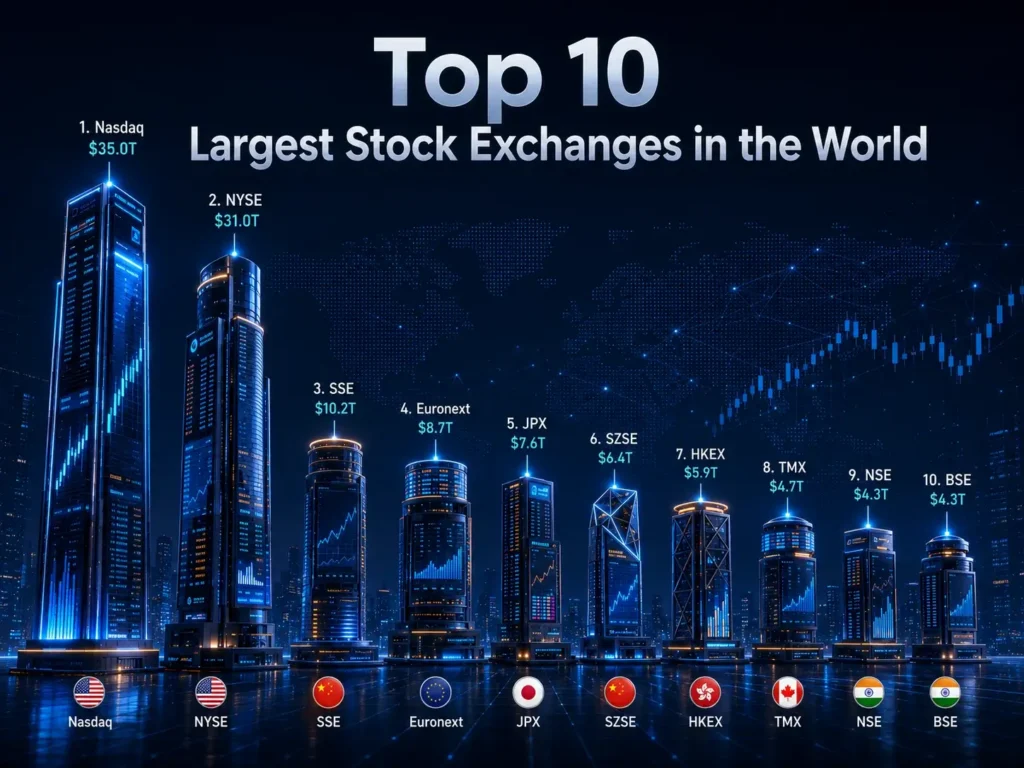
The world’s largest stock exchanges are ranked by the domestic market capitalisation of all companies listed on each exchange. As of March 2026, Nasdaq leads the global ranking for the first time — overtaking the New York Stock Exchange (NYSE) on the back of sustained technology-sector growth, according to the World Federation of Exchanges (WFE). The current top 10 spans two US exchanges, three Chinese markets, Europe’s Euronext, Japan, Hong Kong, Canada, and — for the first time together — both of India’s major exchanges.
This article presents the current global ranking, a profile of each exchange in the top 10, and an overview of the major exchanges immediately outside it.
Key Points
- Nasdaq surpassed the NYSE in 2026 to claim the top position globally by domestic market capitalisation, according to the World Federation of Exchanges — driven largely by the continued expansion of technology and AI-related listings.
- India now places two exchanges in the global top 10 for the first time — the National Stock Exchange (NSE) and BSE India — while the London Stock Exchange has dropped outside the top tier.
- Exchange size, measured by domestic market capitalisation, reflects a market’s liquidity depth, capacity to attract global capital, and influence over regional and international equity benchmarks.
What Is a Stock Exchange?
A stock exchange is a regulated marketplace where shares, bonds, exchange-traded funds (ETFs), and other securities are traded. It provides a structured environment that ensures transparency, efficiency, and adherence to established rules, allowing buyers and sellers to transact with confidence.
These exchanges enable companies to raise capital through initial public offerings (IPOs) and give investors a platform to trade securities in the secondary market. Unlike over-the-counter (OTC) markets, stock exchanges require formal listings and regulatory oversight, helping to standardise trading practices and support investor trust.
Top 10 Largest Stock Exchanges in the World
The standard measure for comparing exchange size is domestic market capitalisation — the combined value of all companies whose primary listing sits on that exchange, calculated by multiplying each company’s share price by its total outstanding shares. This metric reflects the exchange’s scale, depth of listings, and influence in global financial markets.
The table below summarises the current top 10, based on data from the World Federation of Exchanges statistics portal as of March 2026. Rankings can shift month to month as share prices, exchange rates, and listing volumes change.
| Rank | Exchange | Country | Market Cap (March 2026) |
| 1 | Nasdaq | United States | ~$35.0 trillion |
| 2 | New York Stock Exchange (NYSE) | United States | ~$31.0 trillion |
| 3 | Shanghai Stock Exchange (SSE) | China | ~$10.2 trillion |
| 4 | Euronext | Europe | ~$8.7 trillion |
| 5 | Japan Exchange Group (JPX) | Japan | ~$7.6 trillion |
| 6 | Shenzhen Stock Exchange (SZSE) | China | ~$6.4 trillion |
| 7 | Hong Kong Exchanges and Clearing (HKEX) | Hong Kong | ~$5.9 trillion |
| 8 | TMX Group | Canada | ~$4.7 trillion |
| 9 | National Stock Exchange of India (NSE) | India | ~$4.3 trillion |
| 10 | BSE India | India | ~$4.3 trillion |
Disclaimer: The rankings, domestic market capitalisation figures, and year-on-year percentage changes in this section are based on the World Federation of Exchanges’ Market Statistics – May 2026, covering data through March 2026 [1]. Figures have been rounded for readability and may change as market valuations, exchange rates, and listed companies change over time.
1. Nasdaq
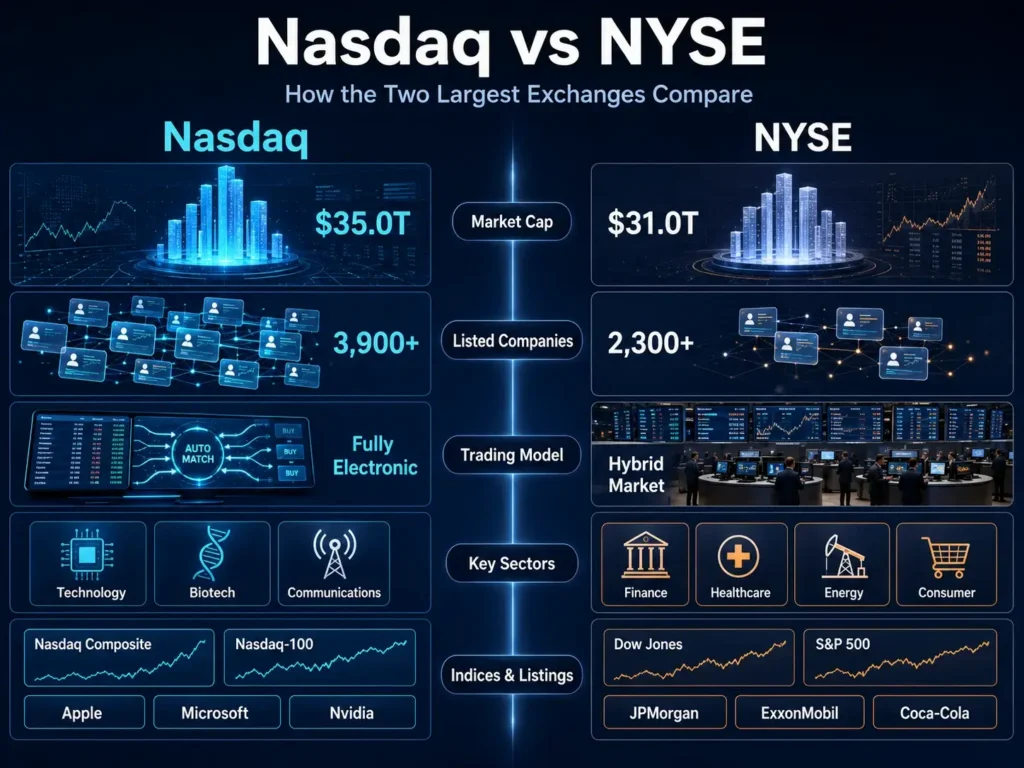
Established in 1971 as the world’s first fully electronic stock exchange, Nasdaq is now the largest in the world by domestic market capitalisation. As of March 2026, its listed companies represent approximately $35.0 trillion — a 29% increase year-on-year according to the WFE — driven by the sustained growth of its technology-heavy listings.
Nasdaq lists more than 3,900 companies, with a strong concentration in technology, biotechnology, and communication sectors. It is home to some of the most widely traded stocks in the world, including Apple, Microsoft, Amazon, Nvidia, and Tesla. Its principal indices are the Nasdaq Composite and Nasdaq-100, both of which track the performance of large-cap and growth-oriented listings.
H3 – 2. New York Stock Exchange (NYSE)
Founded in 1792, the New York Stock Exchange (NYSE) is one of the oldest and most recognised financial institutions in the world. As of March 2026, it holds approximately $31.0 trillion in domestic market capitalisation — a marginal year-on-year decline as Nasdaq’s technology-driven expansion closed and then exceeded the gap between them.
The NYSE lists more than 2,300 companies across a broad range of sectors, including finance, healthcare, energy, and consumer goods, and is the primary home of major indices such as the Dow Jones Industrial Average and the S&P 500. Its hybrid trading model combines an electronic matching engine with human Designated Market Makers on a physical floor — a structure that distinguishes it from fully electronic competitors. Notable listings include ExxonMobil, JPMorgan Chase, and Coca-Cola.
3. Shanghai Stock Exchange (SSE)
Founded in 1990, the Shanghai Stock Exchange (SSE) is one of China’s two primary equity markets and the third largest in the world by domestic market capitalisation. As of March 2026, it holds approximately $10.2 trillion in listed value — a 41% year-on-year increase that makes it the fastest-growing exchange among the current top five, reflecting strong domestic liquidity conditions and policy-backed market development in China.
The SSE lists more than 2,200 companies, including many of China’s largest state-owned enterprises and financial institutions. Its principal indices — the SSE Composite Index and SSE 50 — track the performance of major firms such as the Industrial and Commercial Bank of China (ICBC) and PetroChina.
The exchange operates two share classes: A-shares, denominated in Chinese yuan and primarily available to domestic investors, and B-shares, denominated in US dollars and open to both domestic and international participants. Foreign access to A-shares has broadened significantly through the Shanghai–Hong Kong Stock Connect programme.
4. Euronext
Established in 2000 through the merger of exchanges in Paris, Amsterdam, and Brussels, Euronext is Europe’s largest stock exchange and the fourth largest in the world as of March 2026. Its domestic market capitalisation stands at approximately $8.7 trillion — placing it ahead of the Japan Exchange Group in the current global ranking for the first time, according to Statista data sourced from the WFE.
Euronext now spans eight countries, operating regulated markets across France, the Netherlands, Belgium, Ireland, Portugal, Italy, Greece, and Norway. It lists approximately 1,800 companies and operates major indices including the Euronext 100 and CAC 40. Prominent listings include LVMH, Airbus, ASML, and TotalEnergies.
5. Japan Exchange Group (JPX)
Formed in 2013 through the merger of the Tokyo Stock Exchange and Osaka Securities Exchange, the Japan Exchange Group (JPX) is headquartered in Tokyo. As of March 2026, its domestic market capitalisation reaches approximately $7.6 trillion, making it the largest exchange in Japan and a central hub for the Asia-Pacific region.
The JPX lists nearly 4,000 companies spanning automotive, electronics, robotics, and financial services. Its principal indices — the Nikkei 225 and the TOPIX — are among the most widely tracked benchmarks in Asia. Major listings include Toyota Motor Corporation, Sony Group, and Mitsubishi UFJ Financial Group.
6. Shenzhen Stock Exchange (SZSE)
Established in 1990, the Shenzhen Stock Exchange (SZSE) has risen sharply up the global rankings. As of March 2026, its domestic market capitalisation reaches approximately $6.4 trillion — a 35% increase year-on-year, placing it sixth globally. The SZSE ranked ninth by this measure as recently as May 2025; its rise to sixth represents one of the most significant shifts in the current ranking.
The exchange lists approximately 2,900 companies, with a strong concentration in technology, electric vehicles, renewable energy, and advanced manufacturing. It includes the ChiNext board, designed for high-growth and innovation-oriented companies. Its principal index is the SZSE Component Index, and major listings include BYD Company, Ping An Insurance, and Contemporary Amperex Technology (CATL).
7. Hong Kong Exchanges and Clearing (HKEX)
Hong Kong Exchanges and Clearing (HKEX), established in 2000 through the merger of the Stock Exchange of Hong Kong, Hong Kong Futures Exchange, and Hong Kong Securities Clearing Company, is one of Asia’s leading stock exchanges. As of March 2026, its domestic market capitalisation stands at approximately $5.9 trillion.
HKEX lists more than 2,600 companies, including many mainland Chinese firms seeking access to international investors. Its benchmark Hang Seng Index includes major companies such as Tencent Holdings, HSBC Holdings, and China Mobile. A key role of HKEX is its function as a bridge between mainland China and global capital markets — primarily through the Shanghai–Hong Kong and Shenzhen–Hong Kong Stock Connect programmes, which allow cross-border investment flows between the mainland and Hong Kong markets.
8. TMX Group
Operating the Toronto Stock Exchange (TSX) and TSX Venture Exchange, TMX Group is Canada’s largest securities market. The TSX was founded in 1852, and as of March 2026 TMX Group’s domestic market capitalisation stands at approximately $4.7 trillion — a 35% year-on-year increase, partly reflecting the Canadian dollar’s appreciation against the US dollar over the period.
The TSX lists more than 1,500 companies, with notable concentration in energy, mining, and financial services — sectors that reflect the structure of the Canadian economy. Major listings include Royal Bank of Canada, Shopify, and Enbridge. The S&P/TSX Composite Index tracks the performance of the exchange’s most significant companies.
9. National Stock Exchange of India (NSE)
Founded in 1992, the National Stock Exchange of India (NSE) is the country’s largest exchange by trading volume and one of two Indian exchanges now in the global top 10. As of March 2026, its domestic market capitalisation stands at approximately $4.3 trillion, according to the WFE — below the $5.2 trillion recorded in May 2025, reflecting a correction in Indian equity valuations during the intervening period.
The NSE lists more than 2,000 companies and operates the NIFTY 50 index, which tracks the performance of India’s leading large-cap companies. Major listings include Reliance Industries, Tata Consultancy Services, and Infosys. The NSE introduced electronic trading to India’s equity markets and today handles a significant share of the country’s overall equity trading volume.
India’s other major exchange, BSE India, now also sits in the global top 10 — the first time the two have appeared there together. This reflects the scale of India’s listed-company universe, which has expanded steadily over the past decade.
10. BSE India
Founded in 1875 as the Bombay Stock Exchange, BSE India is Asia’s oldest stock exchange and the tenth largest in the world by domestic market capitalisation. As of March 2026, it holds approximately $4.3 trillion in listed domestic value — marginally below the NSE but effectively at parity in the current WFE ranking, as the two exchange just $2 billion apart in the March 2026 data.
BSE lists more than 5,500 companies, making it one of the largest exchanges in the world by number of listed companies. Its flagship index is the BSE Sensex 30 — commonly known as the Sensex — which tracks thirty of India’s largest and most actively traded companies, including HDFC Bank, Reliance Industries, and Tata Consultancy Services. Together with the NSE, BSE India forms the twin pillars of the country’s equity capital markets.
Beyond the Top 10: Other Major Exchanges
The stock exchange landscape extends well beyond the top 10. According to the World Federation of Exchanges, there are approximately 80 major stock exchanges operating globally. Of these, 21 have a domestic market capitalisation above $1 trillion — a group sometimes referred to as the “$1 Trillion Club”. The remaining exchanges vary widely in size, from regional mid-sized markets to smaller national venues.
Notable exchanges outside the current top 10 include:
| Rank | Exchange | Country | Market Cap (approx.) |
| 11 | London Stock Exchange (LSE) | United Kingdom | ~$4.0 trillion |
| 12 | Taiwan Stock Exchange (TWSE) | Taiwan | ~$3.2 trillion |
| 13 | Korea Exchange (KRX) | South Korea | ~$3.1 trillion |
| 14 | Saudi Exchange (Tadawul) | Saudi Arabia | ~$2.8 trillion |
| 15 | Australian Securities Exchange (ASX) | Australia | ~$2.3 trillion |
The London Stock Exchange, which ranked sixth globally as recently as May 2025, has slipped outside the top 10 as markets in China, India, and Canada expanded.
It remains one of the world’s most internationally connected exchanges, with listings from more than 60 countries and a FTSE 100 index that includes companies such as HSBC Holdings, BP, and Unilever.
How Do These Stock Exchanges Differ?
While the largest stock exchanges share a common role as regulated marketplaces for securities trading, each has distinctive characteristics shaped by its location, the sectors it attracts, and how it connects to global capital flows.
Regional Influence
Each exchange reflects the economic priorities and growth conditions of its home region. Nasdaq and the NYSE represent the depth of the US equity market, which between them account for approximately two-thirds of the global top 10’s combined capitalisation.
In Asia, the Shanghai Stock Exchange, Shenzhen Stock Exchange, Hong Kong Exchanges and Clearing, NSE, and BSE India collectively reflect the continued expansion of capital markets across China, Hong Kong, and India. China’s three exchanges in the top 10 — SSE, SZSE, and HKEX — together represent over $22 trillion in domestic market capitalisation, underscoring the scale of China’s listed-company universe.
In Europe, Euronext spans eight countries under a unified market structure, while the London Stock Exchange, now outside the top 10, continues to serve as an important benchmark for European and international equity markets.
Sector Specialisation
Some exchanges are globally recognised for concentration in specific industries. Nasdaq is synonymous with technology, hosting many of the world’s most influential listed companies in software, semiconductors, and AI. The Toronto Stock Exchange under TMX Group is well known for energy, mining, and natural resources, reflecting Canada’s resource-driven economy.
The Shenzhen Stock Exchange has a strong presence in technology, electric vehicles, and renewable energy — sectors at the centre of China’s industrial policy focus — while the London Stock Exchange features a broad mix including finance, energy, and consumer goods. Sector focus often shapes the types of companies seeking listings and the investor communities each exchange attracts.
Global Reach
The extent of cross-border listings and international connections varies significantly across exchanges. HKEX has historically served as the primary gateway for mainland Chinese companies seeking international capital and for overseas investors seeking China exposure. Euronext is inherently cross-border, operating across eight European countries under a unified trading platform.
The NYSE and Nasdaq host many foreign companies through American depositary receipts (ADRs), providing those firms with access to deep US liquidity. Cross-listings, international trading links, and dual-listed companies strengthen each exchange’s role in the global equity market, allowing capital to flow more freely between regions.
Learn more about global stock trading hours and how they differ across major markets.
Why Size Matters in a Stock Exchange
- Represents Total Market Value: Market capitalisation reflects the combined value of all listed companies and measures an exchange’s overall scale and influence in global equity markets.
- Signals Liquidity: Larger market capitalisation generally means higher trading liquidity, allowing securities to be bought or sold more easily without significant price impact.
- Attracts Diverse Investors: High liquidity draws both institutional and retail participants, enabling more efficient price discovery and smoother trade execution.
- Indicates Investor Confidence: Exchanges with higher market capitalisation typically host financially established, well-governed companies, which can strengthen overall market credibility.
- Acts as an Economic Indicator: Large exchanges can influence regional and global equity markets through their size, trading activity, and international connections.
- Shapes Investor Perception: Large exchanges are typically seen as established and globally connected, while smaller exchanges may offer exposure to niche sectors or emerging markets that larger venues do not cover.
How Traders Can Gain Exposure to These Exchanges
The exchanges, indices, and financial instruments discussed in this article are provided for informational and educational purposes only and should not be interpreted as a recommendation, solicitation, or advice to trade.
Traders looking to access global equity markets linked to the exchanges covered in this article can do so through a range of financial instruments, without holding the underlying shares directly.
Contracts for Difference (CFDs) allow traders to speculate on the price movements of broad market benchmarks and individual company stocks without owning the underlying assets. This includes index CFDs such as the S&P 500, FTSE 100, or Nikkei 225, as well as ETF CFDs and share CFDs linked to companies listed on the exchanges covered in this article.
CFD trading involves significant risk and may not be suitable for all investors. Leverage can magnify both gains and losses. Before entering a position, traders should understand the mechanics of the market being accessed, including the differences between index and stock trading.
Those looking to build their knowledge of global markets can explore Vantage’s Academy, which provides free educational articles and courses across a wide range of trading topics.
Frequently Asked Questions (FAQs)
Which Is the Largest Stock Exchange in the World?
As of March 2026, Nasdaq in the United States is the largest stock exchange in the world by domestic market capitalisation, with approximately $35.0 trillion in listed company value, according to the World Federation of Exchanges. This marks the first time Nasdaq has held the top position in the WFE ranking, having overtaken the New York Stock Exchange (NYSE), which now stands second at approximately $31.0 trillion. The shift reflects Nasdaq’s sustained growth in technology and AI-related listings over recent years.
What Is the Difference Between the NYSE and Nasdaq?
The NYSE is a traditional auction market that combines electronic trading with human Designated Market Makers on a physical trading floor, while Nasdaq operates as a fully electronic exchange with no physical floor presence. The two also differ in the companies they attract: the NYSE is historically associated with large, established blue-chip firms across industries such as finance, energy, and consumer goods, while Nasdaq is strongly linked to technology, biotechnology, and growth-stage companies. Both exchanges apply separate listing requirements and operate under oversight from the US Securities and Exchange Commission.
How Many Stock Exchanges Are There in the World?
There are approximately 80 major stock exchanges operating globally, according to the World Federation of Exchanges, which maintains membership data across regulated markets. Of these, 21 have a domestic market capitalisation above $1 trillion. The precise count varies depending on how exchanges are defined — whether regional venues, specialist boards, and alternative trading platforms are included — but the 80-exchange figure covers the major regulated national and regional markets that account for the bulk of global equity trading volume.
What Is the Difference Between the NSE and BSE?
Both the National Stock Exchange (NSE) and BSE India (formerly the Bombay Stock Exchange) are based in India and are now both ranked in the global top 10 by domestic market capitalisation.
The BSE, founded in 1875, is Asia’s oldest stock exchange and lists more than 5,500 companies — making it one of the largest in the world by number of listings. The NSE, founded in 1992, handles a higher share of India’s overall equity trading volume and is the primary venue for most institutional and retail activity.
The BSE’s flagship index is the Sensex 30, while the NSE’s primary index is the NIFTY 50. Both exchanges operate under regulation from the Securities and Exchange Board of India (SEBI).
Can I Trade on a Foreign Stock Exchange?
Some brokers provide access to international markets. With CFDs, traders can speculate on the price movements of indices, stocks, or ETFs linked to overseas exchanges without directly owning the underlying shares. This allows participation in foreign equity markets without being physically located in the relevant country. Traders should be aware of currency risk, time zone differences, and any fees or regulatory requirements that may apply when trading instruments linked to foreign exchanges.
How Often Does Exchange Market Capitalisation Change?
Market capitalisation changes continuously during trading hours as share prices fluctuate. Broader rankings are typically updated monthly by data providers such as the World Federation of Exchanges, which publishes updated figures each month through its statistics portal. Major shifts in the global ranking — such as Nasdaq overtaking the NYSE in 2026, or the London Stock Exchange moving outside the top 10 — tend to develop gradually over months or years as listed company valuations, currency movements, and new listings reshape relative positions.
RISK WARNING: CFDs are complex financial instruments and carry a high risk of losing money rapidly due to leverage. You should ensure you fully understand the risks involved and carefully consider whether you can afford to take the high risk of losing your money before trading.
Disclaimer: The information is provided for educational purposes only and doesn’t take into account your personal objectives, financial circumstances, or needs. It does not constitute investment advice. We encourage you to seek independent advice if necessary. The information has not been prepared in accordance with legal requirements designed to promote the independence of investment research. No representation or warranty is given as to the accuracy or completeness of any information contained within. This material may contain historical or past performance figures and should not be relied on. Furthermore estimates, forward-looking statements, and forecasts cannot be guaranteed. The information on this site and the products and services offered are not intended for distribution to any person in any country or jurisdiction where such distribution or use would be contrary to local law or regulation.
Reference
- “Market Statistics – May 2026 – Focus” https://focus.world-exchanges.org/issue/may-2026/market-statistics Accessed 18 June 2026