


 Updated
Choosing between CFDs and stocks is one of the first big decisions many traders and investors face. At first glance, they may seem similar because both let you gain exposure to company price movements. But they work very differently.
A CFD (Contract for Difference) is a derivative product that lets you speculate on whether the price of an asset will rise or fall, without owning the asset itself. By contrast, stocks, shares, and equities generally refer to ownership in a company.
Understanding the difference matters because it affects your risk, costs, flexibility, and strategy. If your goal is short-term trading, CFDs may offer tools that suit active market participation. If your goal is long-term investing, traditional shares or equities may be the better fit.
This guide explains how CFDs compare with stocks, shares, and equities, so you can better understand which approach aligns with your goals.
Key takeaways:
- CFDs are trading instruments used to speculate on price movements without owning the underlying asset.
- Stocks, shares, and equities usually mean ownership in a listed company.
- CFDs often offer leverage and make it easier to go long or short, but they also carry higher risk.
- Stocks are typically associated with longer-term investing, company ownership, and in some cases dividends and voting rights.
- The right choice depends on whether you want to trade short-term price moves or invest for long-term growth.
What Are CFDs?

A CFD, or Contract for Difference, is a financial derivative between a trader and a broker. Instead of buying the underlying asset, you enter into a contract based on the asset’s price movement.
When the market moves in your favour, you may profit from the difference between the opening and closing price. If it moves against you, you incur a loss.
For a more detailed introduction, read our guide on what is CFD trading.
CFDs can be used to trade a wide range of markets, including:
One of the main attractions of CFDs is that they allow traders to:
- Use leverage
- Trade rising and falling markets
- Access multiple markets from one platform
However, leverage can magnify both gains and losses, so CFDs are generally considered higher-risk instruments.
What Are Stocks, Shares and Equities?
In most cases, the terms stocks, shares, and equities are used interchangeably to describe ownership in a company.
When you buy a share in a listed company, you typically become a shareholder. Depending on the company and market, that may entitle you to:
- A claim on part of the company’s value
- Potential dividends
- Voting rights on certain company matters
Although “stock,” “share,” and “equity” are often used as synonyms, there are slight differences in usage:
| Term | Typical Meaning |
| Stock | A general term for ownership in one or more companies |
| Share | A specific unit of ownership in a company |
| Equity | Ownership interest in a company; often used in formal or institutional contexts |
For most retail readers, the practical takeaway is simple: when people compare CFDs vs stocks, they are usually comparing trading price movements without ownership versus buying actual company ownership.
CFDs vs Stocks, Shares and Equities: Main Differences
Here is the clearest way to compare them side by side.
| Feature | CFDs | Stocks / Shares / Equities |
| Ownership | No ownership of the underlying asset | Represents ownership in a company |
| Purpose | Short- to medium-term trading and speculation | Long-term investing or portfolio building |
| Leverage | Often available | Usually not used in standard share investing |
| Short selling | Typically straightforward | Often more limited or unavailable for retail investors |
| Dividends | No actual ownership; cash adjustments may apply depending on the position | Shareholders may receive dividends if declared |
| Voting rights | None | Possible, depending on the share class |
| Costs | May include spread, commission, and overnight financing | May include commission, custody, platform, FX, or exchange fees |
| Holding period | Often used for shorter-term positions | Often used for medium- to long-term holding |
| Risk profile | Higher due to leverage and fast market moves | Can still be risky, but generally more straightforward without leverage |
| Market access | Often broad access through one platform | Depends on the broker, exchange access, and product offering |
The biggest practical difference is this:
- CFDs are built for trading
- Stocks are built for ownership and investing
CFD Trading vs Share Trading: How are They Different?
Even when both products are linked to the same company, the user experience can be very different.
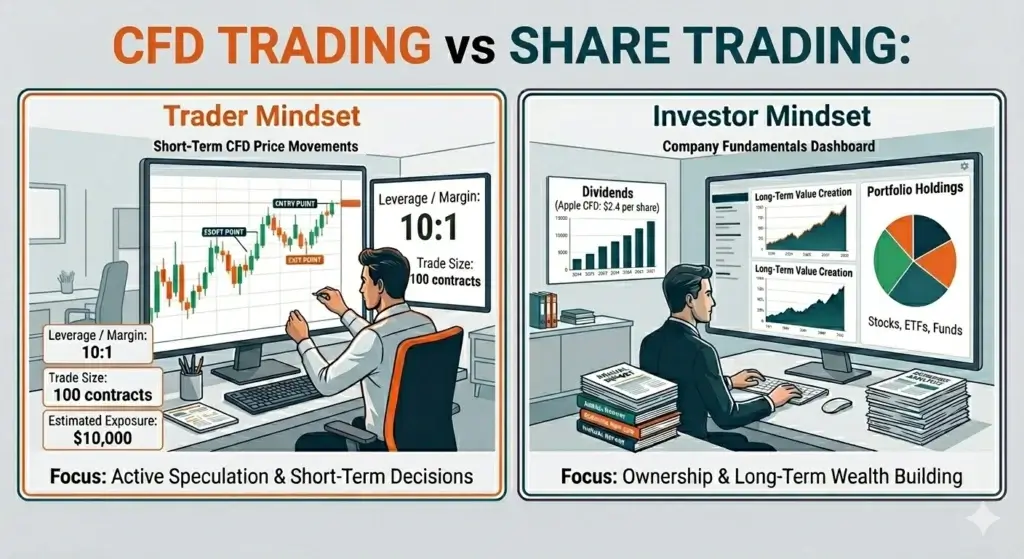
Many beginners may find stocks easier to understand because they involve direct ownership. CFDs can suit beginners who already understand leverage, risk management, and active trading.
When trading CFDs:
You are focused on price action, entry and exit timing, margin, and managing risk over shorter periods.
When buying shares:
You are more likely to focus on company fundamentals, earnings, dividends, business outlook, and long-term value creation.
This is why many people frame the decision as:
CFD trading vs stock investing
That distinction is important. One is more about active speculation, while the other is more about ownership and wealth building over time.
Do You Own the Shares When You Trade a CFD?
No. When you trade a share CFD, you do not own the underlying shares.
That means you generally do not receive the same legal rights as a shareholder, such as:
- Voting rights
- Direct ownership registration
- Shareholder meeting participation
In some cases, a CFD position may receive a dividend adjustment if the underlying company pays a dividend, but this is not the same as owning the stock directly.
This is one of the most important points for beginners to understand.
Similarities Between CFDs and Stocks
Although they are different products, CFDs and stocks do share some similarities.
| Similarity | Explanation |
| Exposure to price movements | Both can gain or lose value as the company’s price changes |
| Market analysis matters | Both often rely on technical, fundamental, or sentiment analysis |
| Company-specific risks apply | Earnings, guidance, regulation, and sector news can affect both |
| Portfolio role | Both can be used to gain exposure to industries, themes, or regions |
So while the structure is different, both products can respond to the same market events.
CFD vs Stocks: Which Is Better for Beginners?
There is no universal answer, because it depends on the beginner’s objective.
Stocks
Stocks are generally associated with longer-term investing, where investors may focus on company ownership, potential dividends, and portfolio growth over time, without the use of leverage in standard share investing.
CFDs
CFDs are derivative instruments that allow exposure to price movements without owning the underlying asset. They involve leverage and the ability to take both long and short positions, and are commonly used for short-term trading strategies.
For many new market participants, Stocks are generally considered simpler in structure as they involve ownership, while CFDs involve additional mechanics such as leverage and margin, which require an understanding of risk management.
Risks of CFDs vs Stocks
A balanced comparison should include the risks, especially because the audit flagged this as a gap.
Risks of CFDs
- Leverage risk: losses can build quickly if the market moves against you
- Volatility risk: short-term moves can trigger stop-outs or margin calls
- Overnight financing: holding positions over time can increase costs
- Complexity: margin, pricing, and risk controls require more experience
Risks of Stocks
- Market risk: share prices can fall significantly
- Company risk: earnings misses, debt issues, or poor management can hurt value
- Liquidity risk: some shares may be harder to buy or sell quickly
- Concentration risk: holding too much of one stock can increase exposure
Neither product is risk-free. The main difference is that CFD risks are typically associated with leverage and short-term price movements, while stock risks are associated with company performance, market conditions, and broader economic cycles.
Costs: CFD Trading vs Stock Investing
Costs can make a meaningful difference, especially depending on how often you trade.
| Cost Type | CFDs | Stocks / Shares |
| Spread | Common | Sometimes embedded in execution |
| Commission | May apply | May apply |
| Overnight financing | Often applies for positions held overnight | Usually not applicable in standard share ownership |
| Custody / platform fees | Usually not structured the same way | May apply depending on broker or market |
| FX conversion | May apply for foreign assets | May apply for foreign market share purchases |
| Exchange / regulatory fees | Depends on product and broker model | Common in many direct share markets |
For short-term traders, execution-related costs are often a major consideration. For long-term investors, fees such as custody or FX conversion may matter more over time.
CFDs vs Equities
CFDs may be more suitable if you:
- commonly used for trading around earnings, macro events, or short-term momentum
- provide access to both rising and falling markets
- involve the use of risk controls and active position management
- offer broad market access from a single trading account
Equities:
- represent ownership in companies
- are often used for long-term portfolio construction
- may provide dividends and shareholder rights depending on the stock
- are generally associated with a simpler investment structure
Example: Buying a Stock vs Trading a CFD
Imagine you want exposure to a major global technology company.
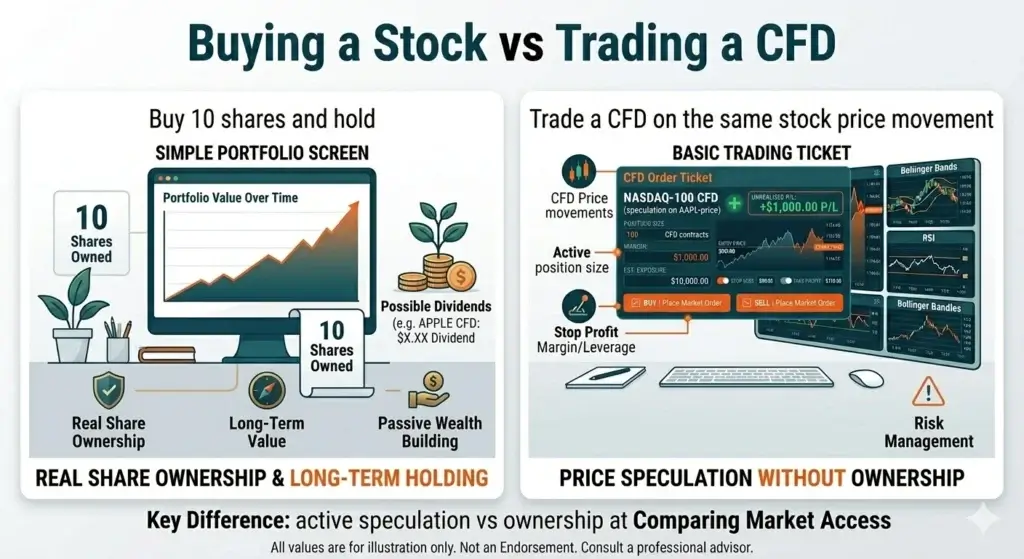
If you buy stock:
You purchase actual shares and hold them in your account. Your returns depend on the company’s share price performance over time, and you may receive dividends if the company pays them.
If you trade CFD:
You do not own the underlying shares. Instead, you speculate on whether the stock price will rise or fall. Your outcome depends on the price movement, your position size, whether leverage is used, and how long you keep the trade open.
CFDs vs Stocks: Final Thoughts
CFDs and stocks can both provide exposure to market opportunities, but they are built for different purposes.
If you are looking for ownership, long-term exposure, and a traditional investment approach, stocks, shares, or equities may be more suitable.
CFDs offer flexibility in accessing short-term price movements and the ability to take both long and short positions. However, they involve leverage and carry a high level of risk, which may not be suitable for all traders.
The key is not deciding which product is “better” in absolute terms. It is deciding which one is better for your objective, time horizon, and risk tolerance.
Frequently Asked Questions (FAQs)
What is the main difference between a CFD and a stock?
A CFD is a derivative that lets you speculate on price movements without owning the underlying asset. A stock represents ownership in a company.
Are stocks, shares, and equities the same thing?
In most retail investing contexts, yes. They are often used interchangeably, although “share” usually refers to a specific unit of ownership, while “stock” and “equity” can be broader terms.
Do you own the shares when you trade CFDs?
No. When you trade a CFD on a share, you do not own the actual shares.
Is CFD trading riskier than buying stocks?
It can be, especially when leverage is used. Leverage magnifies both gains and losses, making CFD trading more complex and potentially more volatile.
Can you short-sell with stocks?
In some markets and with some brokers, yes, but it is typically less straightforward than shorting through CFDs.
Are CFDs better for short-term trading?
They are often used that way because they allow traders to react quickly to price movements and take both long and short positions.
Are stocks better for long-term investing?
They are often more closely associated with long-term investing because they represent ownership and may provide dividends and shareholder rights.
Do CFDs pay dividends?
It depends on the broker, market, and holding period. CFDs may involve spreads, commissions, and overnight financing, while stocks may involve commissions, exchange fees, and FX conversion.
Which is better for beginners: CFDs or stocks?
Many beginners may find stocks easier to understand because they involve direct ownership. CFDs can suit beginners who already understand leverage, risk management, and active trading.
Risk Warning: CFDs are complex financial instruments and carry a high risk of losing money rapidly due to leverage. You should ensure you fully understand the risks involved and carefully consider whether you can afford to take the high risk of losing your money before trading.
Disclaimer: The information is provided for educational purposes only and doesn’t take into account your personal objectives, financial circumstances, or needs. It does not constitute investment advice. We encourage you to seek independent advice if necessary. No representation or warranty is given as to the accuracy or completeness of any information contained within. This material may contain historical or past performance figures and should not be relied on. Furthermore estimates, forward-looking statements, and forecasts cannot be guaranteed. The information on this site and the products and services offered are not intended for distribution to any person in any country or jurisdiction where such distribution or use would be contrary to local law or regulation.