


 Updated
Exchange-Traded Funds (ETFs) and index funds are two of the most popular ways to gain exposure to a wide range of markets. Both are designed to track the performance of specific benchmarks, such as the S&P 500, but the way they operate is different.
Many investors often compare ETF vs index fund options to see which might align with their financial goals. The distinctions matter, whether the focus is on costs, flexibility, or investment time horizon.
The comparison is important because passive investing has become a dominant force in global markets. As both ETFs and index funds often carry lower costs than actively managed funds, recognising their differences can help traders see which structure best aligns with their strategy and long-term objectives.
Key Points
- ETFs are tradeable throughout the day on exchanges offering greater flexibility, while index funds are traded once at the end of the trading day directly with fund managers.
- ETFs may incur broker commissions and are subject to bid-ask spreads, whereas index funds might have a sales charge but no bid-ask spread, trading at net asset value.
- Both ETFs and index funds provide diversification, with ETFs accommodating a wider range of investment styles and index funds typically offering predictability with less intra-day volatility.
What Are Index Funds and ETFs?
ETFs and index funds share a common goal: to track the performance of market benchmarks with efficiency and transparency.
Despite their similarities, their structures differ in important ways. Understanding how each works provides the foundation for comparing index fund vs ETF options more meaningfully.
What Is an ETF?
An Exchange-Traded Fund (ETF) is a pooled investment vehicle that holds a basket of assets, such as equities, bonds, commodities, or even digital assets. Its primary feature is that it trades on the stock exchange, just like a share, allowing investors to buy and sell throughout the trading day.
ETFs come in many forms. Sector ETFs focus on specific industries such as technology or healthcare. Regional ETFs concentrate on certain markets, like Asia or Europe. Index ETFs are among the most widely known — for example, an S&P 500 ETF mirrors the performance of the S&P 500 index, giving investors broad exposure to leading US companies.
What Is an Index Fund?
An index fund is a type of mutual fund built to track the performance of a specific market index. Instead of relying on a fund manager to actively select securities, the index fund simply replicates the composition of its chosen benchmark. This structure makes it a straightforward and cost-efficient way to access diversified market exposure.
It’s important to distinguish between index mutual funds and index ETFs. Both track indices, but index mutual funds are only priced once at the end of each trading day, while index ETFs trade on exchanges throughout the day. This operational difference often influences how investors choose between them.
ETF vs Index Fund: At-a-Glance Comparison
| Feature | Index Fund | ETF |
| Core Purpose | Tracks the performance of a specific market index | May track indices or a broader range of securities, including bonds, commodities, or derivatives |
| Trading | Priced and traded once per day, after market close | Trades on exchanges throughout the trading day, like shares |
| Pricing | Always bought or sold at net asset value (NAV); no bid-ask spread | Priced in real time with transactions subject to a bid-ask spread |
| Costs | May include sales charges; typically lower expense ratios than actively managed mutual funds | Expense ratios depend on the fund’s structure (passive or active); brokerage commissions may apply |
| Diversification | Provides exposure to all securities within the tracked index | Provides diversification across underlying securities or market segments |
Key Differences Between ETFs and Index Funds
While ETFs and index funds share the goal of tracking benchmarks, their structures create practical differences that shape how investors use them. These differences influence everything from trading flexibility to cost efficiency.Looking at liquidity, fees, and minimum investment requirements highlights the main contrasts in the index fund vs ETF discussion.
1. Liquidity
One of the clearest distinctions in the ETF vs index fund debate lies in liquidity. ETFs can be traded throughout the day, just like individual shares. Prices fluctuate in real time, giving investors the flexibility to react quickly to market movements.
Index funds, by contrast, are only priced once daily, after the market closes. Orders placed during the day are executed at that end-of-day price, which limits the ability to respond to short-term changes.
2. Fees and Expenses
The fee structures also differ. ETFs often involve broker commissions and transactions occur at a bid-ask spread, which can slightly affect the cost of trading. However, many ETFs maintain relatively low ongoing expense ratios, especially those that are passively managed.
Index funds do not involve a bid-ask spread, as they are always bought and sold at their net asset value (NAV). Still, some carry sales charges, and expense ratios can vary depending on the provider.
3. Minimum Investment
Minimum investment requirements are another practical difference. Most ETFs have no set minimum — investors can buy as little as a single share, making them accessible to a wide range of market participants.
Index funds often impose minimums that range between USD500 and USD5,000. These thresholds can be a barrier for some, though they are common among traditional mutual fund structures.
Similarities Between ETFs and Index Funds
Despite their structural differences, ETFs and index funds share several core features that make them appealing to investors. Both are designed with accessibility and cost-efficiency in mind, offering straightforward ways to gain market exposure.
1. Diversification
A key similarity is diversification. Whether through an ETF or an index fund, investors can gain broad exposure to multiple sectors, regions, or asset classes without purchasing each individual security. This spreads risk across many holdings and reduces reliance on the performance of any single company.
2. Cost Efficiency
Another similarity lies in their cost structure. Passively managed ETFs and index funds typically have lower expense ratios than actively managed funds. By replicating an index instead of relying on constant decision-making by fund managers, operating costs remain lean.
3. Transparency
Both ETFs and index funds usually provide clear visibility into their holdings. Investors can easily see which securities are included in the portfolio and how these align with the benchmark being tracked. This transparency builds confidence and helps in comparing performance against the underlying index.
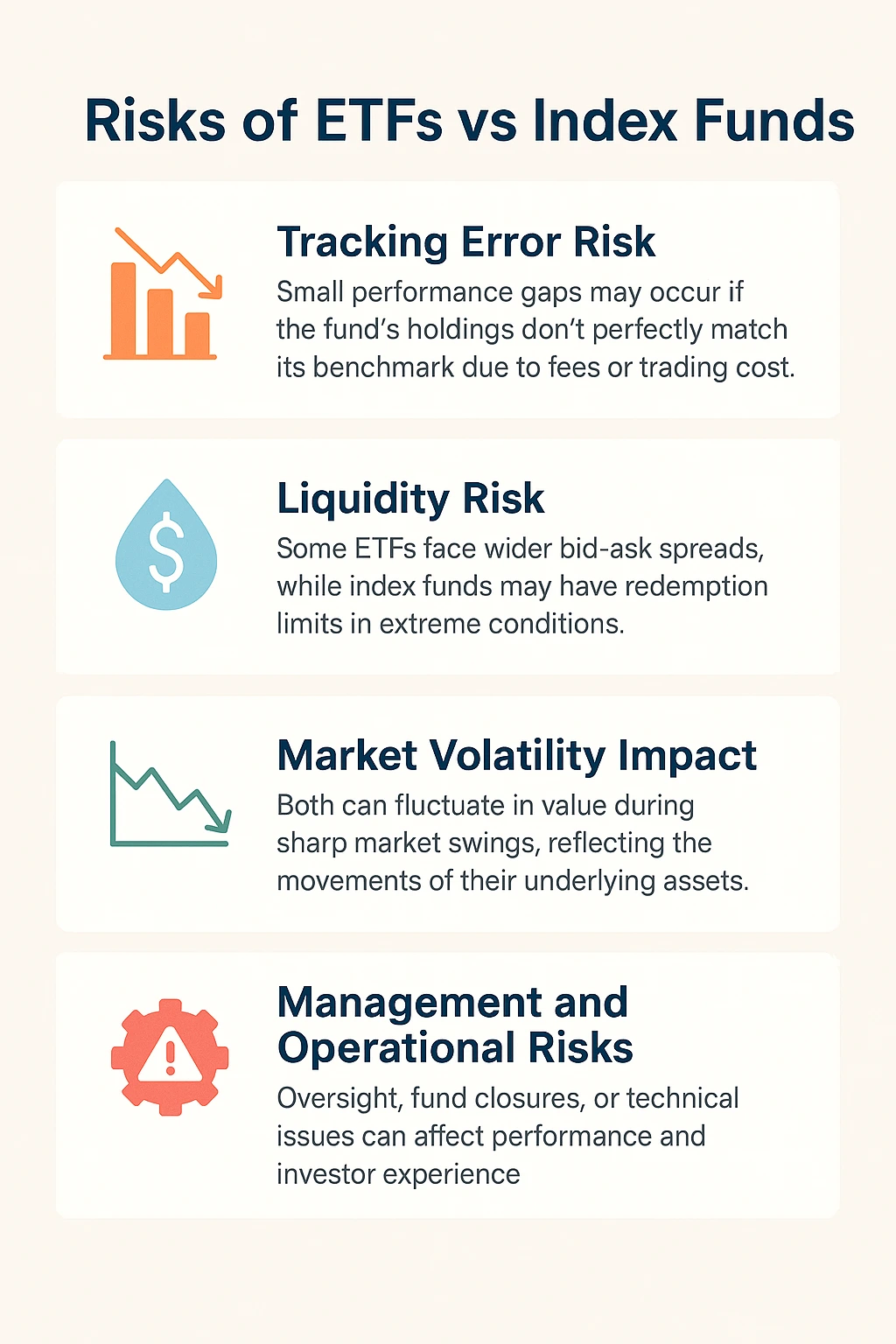
Risks of ETFs vs Index Funds
While ETFs and index funds are often seen as simple ways to access markets, they still carry risks worth considering:
Tax Considerations
ETFs are often viewed as more tax-efficient because they can use in-kind redemption processes, which may help reduce taxable events. Index funds, on the other hand, can generate more taxable distributions, depending on fund activity. Regional tax rules vary, so investors should always refer to official tax authorities or consult licensed professionals for guidance.
Short-Term and Long-Term Considerations
| Investor Type | ETFs | Index Funds |
| Short-Term / Active | Flexible trading throughout the day, often preferred for short-term or more active strategies. | Less flexibility, as transactions are processed once daily. |
| Long-Term / Buy-and-Hold | May be used for long-term, but trading costs could add up over time. | Typically align with long-term, buy-and-hold approaches. |
How to Choose Between an ETF and an Index Fund
When comparing the two, consider the following factors:
- Costs and Fees: Expense ratios, commissions, and bid–ask spreads.
- Trading Style and Flexibility: ETFs trade throughout the day; index funds process once daily.
- Minimum Investment Requirements: ETFs generally have no set minimum; index funds may require an initial amount.
- Tax Treatment and Account Type: Tax efficiency may vary depending on structure and jurisdiction.
- Risk Tolerance and Goals: Match the fund type to your time horizon and comfort with market swings.
Example: S&P 500 ETF vs S&P 500 Index Fund
Both the S&P 500 ETF and the S&P 500 index fund aim to replicate the performance of the same benchmark, the S&P 500 Index. This means they provide investors with similar market exposure across large US companies.
The key difference lies in how they are accessed. An ETF trades throughout the day on an exchange, offering more liquidity and flexibility. By contrast, an index fund is priced once daily at market close, which can limit short-term trading options.
Costs also vary. ETFs may involve commissions and bid–ask spreads in addition to their expense ratios, while index funds generally focus on expense ratios but may require upfront sales charges. Minimum investments are another distinction: ETFs usually have no set minimum, whereas index funds often require an initial amount.
In summary, both track the same benchmark but differ in structure and practical considerations, as outlined below:
| Aspect | S&P 500 ETF | S&P 500 Index Fund |
| Benchmark | Tracks the S&P 500 Index | Tracks the S&P 500 Index |
| Liquidity | Trades throughout the day on exchanges | Priced once daily at market close |
| Costs | May include commissions and bid–ask spreads | Expense ratio only, though some funds may include sales charges |
| Minimum Investment | No set minimum | Often requires an initial investment amount |
ETFs and Index Funds: Key Takeaways
Both ETFs and index funds offer accessible ways to diversify across a wide market benchmark, making them popular choices for many types of investors. The right fit often depends on individual factors such as trading style, long-term goals, and cost considerations.
For those interested in trading ETFs, Vantage provides access to CFDs on the world’s most followed indices and funds, allowing you to explore opportunities with flexibility.
Trade the world’s most popular CFDs on ETFs with Vantage.
FAQs
1. Are ETFs better than index funds?
ETFs and index funds both aim to track market benchmarks, but they are structured differently. ETFs trade like shares on an exchange throughout the day, while index funds are priced once daily. This means ETFs offer more flexibility, but index funds may be simpler for long-term investors.
Rather than one being “better” than the other, the choice depends on individual circumstances. Factors such as trading style, cost sensitivity, and investment horizon will influence which type of fund is more suitable.
2. Is the S&P 500 an ETF or index fund?
The S&P 500 itself is not a fund but an index that measures the performance of 500 large US companies. It serves as a benchmark that many ETFs and index funds aim to replicate.
For example, the SPDR S&P 500 ETF and several mutual fund versions of the S&P 500 index fund are built to track this benchmark, offering investors access to the same underlying performance through different structures.
3. Can an ETF also be an index fund?
Yes. Many ETFs are structured as index funds because they passively follow a benchmark rather than relying on active management. This makes them similar to traditional index funds in terms of strategy.
The main distinction is in how they are traded.
4. Do ETFs or index funds have lower fees?
Both ETFs and index funds are generally considered cost-efficient options, especially when passively managed. Expense ratios for both tend to be lower than actively managed funds, though ETFs may involve additional costs like bid–ask spreads and commissions.
Index funds, by comparison, often avoid bid–ask spreads but may include minimum investment requirements or upfront sales charges. The fee structure varies by provider, so it is important to review each fund’s documentation.
5. Can you lose money with ETFs and index funds?
Yes. Both ETFs and index funds reflect the performance of the underlying securities they track, which means they can decline in value during market downturns. As with any investment, there is the potential for both gains and losses.
While diversification across many assets may reduce risk compared to single-stock investing, it does not eliminate it entirely. Market conditions, trading costs, and tax implications can all influence returns.
6. What is the main advantage of ETFs over index funds?
The primary advantage of ETFs is trading flexibility. Because they are listed on exchanges, they can be bought and sold at market prices throughout the trading day, allowing investors to respond quickly to price movements.
Index funds, by contrast, are priced only once daily at the NAV. This makes them less flexible for those who want to adjust their positions intraday, but it may suit long-term investors who are less focused on short-term trading.
References
- “What Is the Minimum Amount of Money that I Can Invest in a Mutual Fund? – Investopedia”. https://www.investopedia.com/ask/answers/111714/what-minimum-amount-money-i-can-invest-mutual-fund.asp . Accessed 05 Oct 2022.