


 Updated
Trying to compare CFDs and futures? Both let you gain exposure to price movements without buying the underlying asset outright, but they work in different ways. This guide explains the main differences in plain language, including structure, pricing, flexibility, costs, and what traders may want to consider before choosing between them.
Key Takeaways
- CFDs and futures are both derivatives, but they differ in how they are structured and traded.
- CFDs are usually offered through brokers and often provide more flexible position sizing.
- Futures are standardised contracts traded on exchanges, which can make pricing and contract terms more uniform.
- Costs are not always charged in the same way, so the lower-cost option can depend on the market, product, and holding period.
- In Australia, CFDs are subject to ASIC product intervention measures for retail clients, while exchange-traded futures operate within the ASX derivatives market framework.
What Are CFDs?
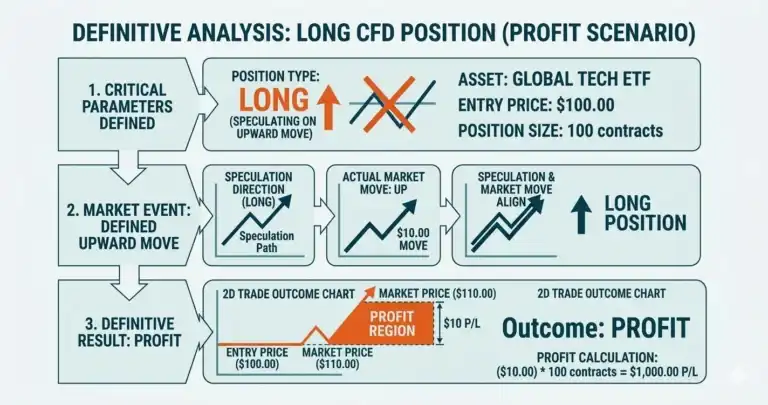
A Contract for Difference, or CFD, is a derivative contract between a trader and a provider. Instead of buying the underlying asset itself, the trader gains exposure to the price movement of that asset. If the market moves in the chosen direction, the position may generate a profit. If it moves the other way, the position may generate a loss.
In practice, CFDs are commonly used to speculate on products such as forex, indices, shares, commodities, and sometimes cryptocurrencies. One of their best-known features is flexibility. Many CFD products allow traders to adjust position size more precisely than standardised exchange contracts, which can make them easier to compare for smaller accounts.
CFDs are complex and high risk, and use leverage, which can magnify both gains and losses.
What Are Futures?
A futures contract is a standardised agreement to buy or sell an underlying asset at a future date on terms set by the contract. Unlike CFDs, futures are traded on exchanges rather than being structured as over-the-counter broker products.
This exchange-based structure is one of the main reasons futures are often described as more standardised. Contract size, expiry date, and settlement terms are defined in advance. In Australia, ASX explains futures as legally binding agreements and notes that they are traded through its derivatives market infrastructure.
Futures are used for different purposes, including speculation and hedging. Depending on the market, they may cover instruments such as equity indices, interest rates, energy products, or other commodities.

Key Differences Between CFDs and Futures
Market Structure
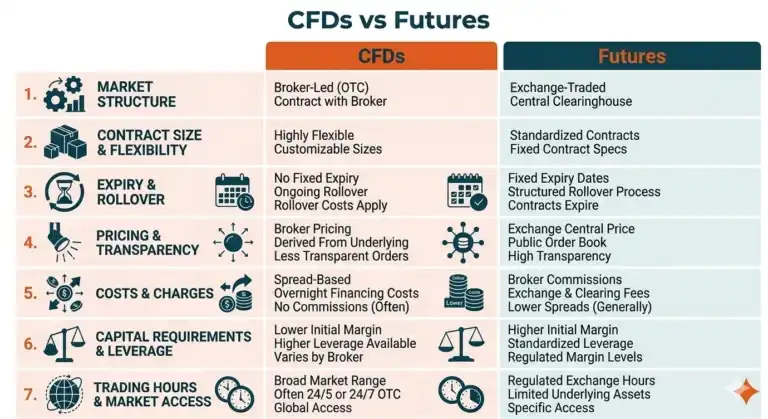
One of the clearest differences is how the two products are traded. CFDs are generally over-the-counter products offered by brokers or providers. Futures are traded on exchanges, where contract terms are standardised and the market operates within a centralised framework.
This difference in structure can affect how traders think about pricing, execution, transparency, and market access. For some readers, the broker-based structure of CFDs feels more straightforward. For others, the exchange-based nature of futures is an important advantage.
Contract Size and Flexibility
CFDs often allow more flexible sizing. This can make them easier to tailor to different account sizes, especially when a trader wants smaller exposure.
Futures are usually based on fixed contract sizes. In practical terms, this means a trader may have less flexibility when trying to fine-tune position size. Smaller contracts may exist in some futures markets, but the structure remains standardised rather than fully adjustable.
Expiry and Rollover
Most CFD products do not have a fixed expiry date in the same way futures contracts do, although holding terms and financing charges may still apply.
Futures contracts usually have a defined expiry month or settlement cycle. Traders who want to maintain exposure beyond that point may need to close the existing contract and move into a later one, depending on the market.
Pricing and Transparency
Because futures trade on exchanges, contract terms and price formation are generally more standardised. ASX describes its futures market as regulated and transparent, which is part of the appeal for some market participants.
CFDs, by contrast, are provider-issued products. That does not automatically make them unsuitable, but it does mean traders need to understand how the provider prices the product, what spread applies, and whether other charges are involved.
Costs and Charges
The cost comparison between CFDs and futures is not always simple. With CFDs, traders may face spreads, commissions in some cases, and overnight financing or swap charges when positions are held beyond the trading day.
With futures, traders may face brokerage, exchange-related costs, and margin requirements. There may also be practical costs linked to rolling positions if a trader wants to stay in the market across contract expiries.
For short-term trades, the cost difference may look one way. For longer-held positions, it may look another. That is why the lower-cost choice is not always the same for every trader.
Capital Requirements and Leverage
Both CFDs and futures can involve leverage, which means traders gain market exposure with a smaller upfront amount than the full notional value of the position. That can increase efficiency, but it also increases risk.
Moneysmart warns that leveraged products can magnify losses as well as gains. In Australia, ASIC’s product intervention measures for retail CFD clients include leverage limits, margin close-out rules, negative balance protection, and restrictions on inducements.
Trading Hours and Market Access
CFDs often provide broad weekday access across major markets such as forex, indices, commodities, and shares, depending on the provider and product.
Futures trading hours depend on the exchange and the contract session. Some futures markets operate for long hours, but they still follow exchange-defined trading schedules rather than a broker-led product model.
| Feature | CFDs | Futures |
| Market structure | Usually traded through a broker or provider | Traded on an exchange |
| Contract terms | Product terms can vary by provider | Standardised contract specifications |
| Position sizing | Often more flexible | Based on fixed contract sizes |
| Expiry | Often no fixed expiry in the same way as futures | Usually has a set expiry or settlement cycle |
| Pricing | Depends on provider pricing model and market feed | Exchange-traded pricing |
| Common costs | Spread, commission in some cases, overnight financing | Commission, exchange or clearing-related costs, margin requirements |
| Holding period | Often used for short- to medium-term trading | Can be used for short-term speculation or longer hedging, depending on contract |
| Access for smaller accounts | Often more accessible because of flexible size options | Can be less flexible because of standardised contracts |
CFD vs Futures in Australia
For Australian readers, the comparison becomes more useful when local market structure is added to the picture.
Regulation in Australia
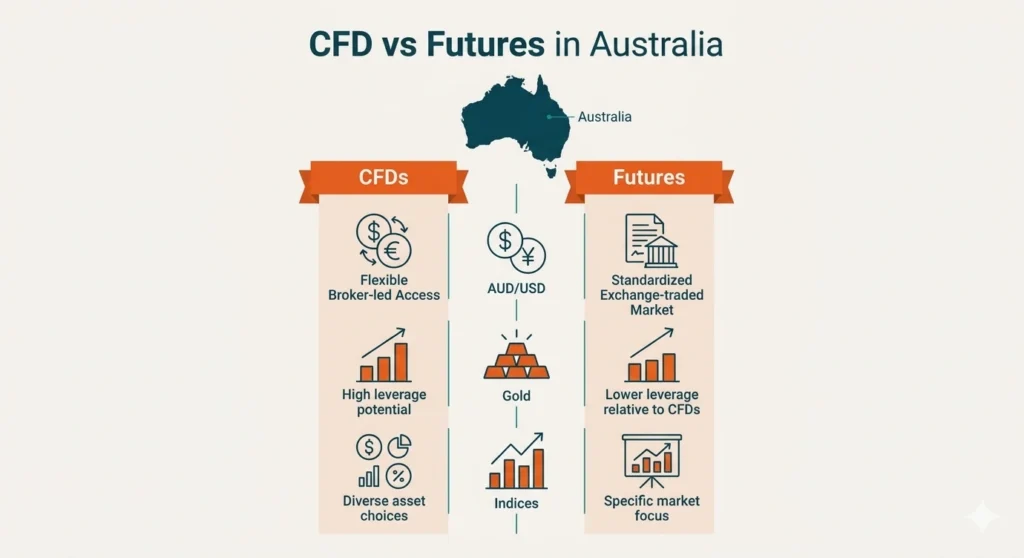
CFDs offered to retail clients in Australia are shaped by ASIC product intervention measures. ASIC has stated that these measures include leverage limits, margin close-out rules, negative balance protection, and restrictions on inducements.
Futures, on the other hand, are typically understood through the exchange-traded derivatives framework. ASX describes futures as standardised and exchange-traded, with its derivatives market operating within a regulated environment.
General Tax Considerations
Tax treatment can depend on the product, the nature of the trading activity, and the trader’s own circumstances. In Australia, the ATO has published specific guidance on CFDs, so tax treatment should not be assumed to work in exactly the same way across every derivative product. For that reason, it is usually sensible to refer to current ATO guidance or obtain independent tax advice where needed.
Markets Australian Traders Commonly Compare
Australian readers comparing CFDs and futures often look at products tied to:
- major forex pairs such as AUD/USD
- gold and oil
- stock indices
- interest-rate products
- selected local or internationally linked share exposures
The better fit can depend on whether the reader values flexible access across broker platforms or prefers the standardised structure of exchange-traded contracts.
CFD vs Futures: Which is More Suitable for You?
Neither market is automatically better in every situation. The better fit usually depends on what the trader values most.

Traders Looking for More Flexible Position Sizing
CFDs may appeal more to traders who want smaller or more adjustable trade sizes. This can make them easier to compare for readers with tighter capital constraints or those who want more precision in exposure.
Traders Who Prefer Standardised Contracts
Futures may appeal more to traders who value exchange-based pricing, fixed contract terms, and a more standardised market structure. For some readers, this is one of the main reasons futures stand out in the comparison.
Traders Comparing Holding Costs and Structure
Readers planning to hold positions for longer may pay closer attention to how financing, expiry, rollover, or contract-related costs work in practice. In those cases, the decision is often less about which product sounds simpler and more about how the product behaves over time.
Traders Comparing Market Access
Some readers prefer the breadth of markets often available through CFD platforms. Others focus on specific futures contracts and prefer the discipline of exchange-defined products. The better fit depends on whether flexibility or standardisation matters more to the individual trader.
Key Takeaways for Australian Traders
When comparing CFDs and futures, the main distinction usually comes down to flexibility versus standardisation. CFDs may appeal to readers who want adjustable position sizing and broad broker-led market access, while futures may suit those who prefer exchange-based pricing and fixed contract terms. The more suitable choice depends on account size, market preference, cost sensitivity, and how the trader wants to manage exposure.
Frequently Asked Questions
What is the difference between CFDs and futures?
Both are derivatives, but they are structured differently. CFDs are commonly offered through brokers and often allow more flexible position sizing, while futures are standardised exchange-traded contracts with defined specifications.
Are CFDs or futures more flexible for smaller accounts?
CFDs are often seen as more flexible for smaller accounts because position size can usually be adjusted more easily. Futures may be less flexible because they are based on standardised contracts.
Are futures more transparent than CFDs?
Some readers view futures as more transparent because they trade on exchanges with standardised terms. CFDs are provider-issued products, so it is important to understand the provider’s pricing model, spread structure, and other product terms.
Can Australian traders access both CFDs and futures?
Availability depends on the provider, platform, and account type. In broad terms, Australian traders may be able to access both, but access conditions and product terms can differ.
Are CFDs regulated in Australia?
Yes, retail CFD offerings in Australia are subject to ASIC product intervention measures.
Are CFDs and futures taxed the same way in Australia?
Tax treatment can vary depending on the product and the individual circumstances. The ATO has published guidance on CFDs, so readers should not assume that all derivatives are treated in exactly the same way for tax purposes.
Who Is This Guide For?
This guide is written for readers in Australia who want a clear comparison between CFDs and futures. It is designed for beginners and intermediate readers who want to understand the basics before deciding which market structure makes more sense for their goals, capital, and preferred way of trading.