


[DAILY TRADING] USDJPY Analysis 10 June 2026 — At 160.37, Why the Rate Gap of Up to 300bp Still Has the Dollar Bid

Vantage Editorial Team >
Vantage Editorial Team >
Vantage is a global, multi-asset broker with a team of in-house writers and market analysts who produce educational and insightful trading content for traders of all levels.
 Updated Wed, 2026 June 10 03:25
![[DAILY TRADING] USDJPY Analysis 10 June 2026 — At 160.37, Why the Rate Gap of Up to 300bp Still Has the Dollar Bid](https://www.vantagemarkets.io/en/wp-content/uploads/sites/22/2026/06/usdjpy_hero.webp)
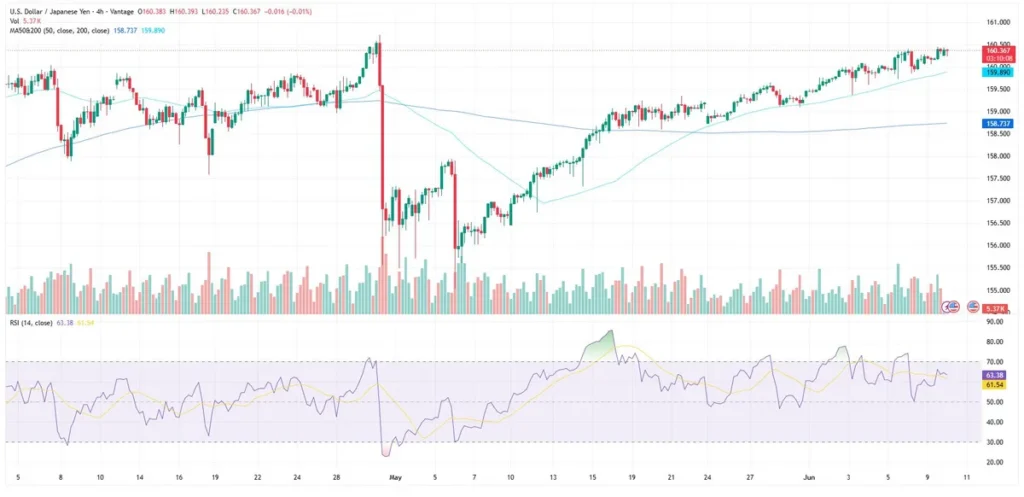
The Vantage USDJPY CFD closed at 160.367 as of 01:49 UTC on 10 June 2026 (09:49 GMT+8). Japan has spent over USD 73 billion on currency intervention since late April, yet the pair is back at the same level.[1] The reason is not complicated: the policy rate gap between the US Federal Reserve (Fed) and the BoJ sits at up to 300 basis points, and carry trade flows are still running.[2] With the Bank of Japan (BoJ) meeting on 16 June, that spread is the number to watch. All prices are from the Vantage USDJPY CFD. This is not financial advice.
Key points
- USDJPY was at 160.367 on the Vantage CFD at 01:49 UTC on 10 June 2026, with the 4H 50-period MA at 158.74 and the 4H 200-period MA at 159.89 both sitting below price as support.
- The policy rate gap between the Fed (3.50%-3.75%) and the BoJ (0.75%) stands at up to 300 basis points as of June 2026; this spread has narrowed from the 2024 peak but remains wide enough to sustain carry trade demand for the dollar.
- Bloomberg reported on 4 June that BoJ officials are considering a rate increase to 1.00% at the 16 June meeting; even if passed, the spread would narrow further but remain positive.
What the 4H chart shows
The 4H chart covers roughly six weeks of price action. The sharp spike lower in late April and early May, down to the 155.50-156.00 area, coincided with the confirmed intervention period in which Japan sold foreign assets to fund yen purchases.[1] The recovery from that low was orderly and has been sustained through May and into June.
Both 4H moving averages are below current price. The 4H 50-period MA (158.74) has been rising since mid-May. The 4H 200-period MA (159.89) is flatter but also below price. Note these are 4H chart averages, not daily MAs; on the daily chart the picture looks different. The RSI (14) on the TradingView setup used for this analysis reads 63.38, signal line at 61.54. Neither reading is in overbought territory.
The rate gap keeping USDJPY elevated
Where the spread stands today
The BoJ policy rate stands at 0.75% against the US Federal Funds rate of 3.50%-3.75%, a gap of up to 300 basis points, according to CNBC.[2] That widening has come from both sides: three US Federal Reserve officials dissented against easing language at the May FOMC meeting, pushing back on rate cut expectations, while the BoJ held at 0.75% in April with a 6-3 vote split that signalled growing hawkishness without delivering an immediate hike.[3]
The spread has compressed significantly since the 2024 carry trade peak.[4] The July 2024 carry trade unwind, which Reuters reported was triggered by a Bank of Japan rate increase and weaker US jobs data, saw USDJPY fall from near 162 to below 142 within weeks. The policy rate gap is now considerably narrower than it was at that point, and the risk-reward of carry positions has shifted accordingly.[4]
What a BoJ hike to 1.00% would change
Bloomberg reported on 4 June that BoJ officials are actively considering raising the policy rate to 1.00% at the 16 June meeting.[5] The April meeting produced a 6-3 vote, with board members Nakagawa, Takata and Tamura all voting for an immediate hike to 1.00%, the most hawkish split under Governor Ueda’s tenure, according to CNBC.[3]
A hike to 1.00% would narrow the policy rate gap to approximately 2.50%-2.75% on a simple rate basis.[2] That still leaves positive carry for dollar holders, but the cushion against adverse yen moves shrinks further.[4]
US-Japan rate spread in context
The table below shows where the spread stands today against recent history and forward pricing. These figures are for reference only.
| Rate | Context | |
| US Fed funds rate | 3.50%-3.75% | Held since late 2025; Fed officials divided on easing path |
| BoJ policy rate | 0.75% | Held at April meeting; June hike under active consideration |
| Implied spread | up to 300bp | US-Japan policy curve spread as of early June 2026 |
| Peak spread (2024) | ~525bp | When carry trade was at its most crowded |
| Spread if BoJ hikes to 1.00% | ~250-275bp (simple rate basis) | Simple arithmetic: Fed 3.50%-3.75% minus BoJ 1.00% |
Table 1: US-Japan policy rate spread summary as of early June 2026. Sources: Bloomberg, CNBC, Trading Economics. Indicative only.
What to watch
- BoJ meeting, 16 June: Markets are increasingly pricing a rate increase to 1.00%. The vote count and forward guidance on further tightening pace are the primary event risk for the USDJPY live price this week.
- US CPI, 11 June: A cooler reading could revive Fed cut expectations and compress the rate spread from the US side; a hot print reinforces the case for a wider differential.
- Carry positioning: The 2024 unwind showed that carry trades do not erode gradually; they snap. Market participants often monitor open interest and speculative positioning data around events that could shift the rate outlook sharply.
- Japan Ministry of Finance: Finance Minister Katayama reiterated on 8 June that authorities remain ready to act in the forex market.[1]
Market participants monitoring USDJPY near 160 often note that the pair has historically produced rapid moves when either official intervention or a shift in carry positioning occurs. The July 2024 episode saw approximately 20 figures of downside in three weeks.[4] Market participants often monitor the 4H moving-average support zones at 158.74 and 159.89 as stop loss levels during periods of heightened event risk.
Leverage amplifies both gains and losses in CFD trading. In a pair where the primary driver is a rate spread that can reprice sharply within a single session, position sizing relative to account equity is one factor market participants often consider, particularly ahead of the 16 June BoJ meeting.
RISK WARNING: CFDs are complex financial instruments and carry a high risk of losing money rapidly due to leverage. You should ensure you fully understand the risks involved and carefully consider whether you can afford to take the high risk of losing your money before trading.
Disclaimer: The information is provided for educational purposes only and does not take into account your personal objectives, financial circumstances, or needs. It does not constitute investment advice. We encourage you to seek independent advice if necessary. The information has not been prepared in accordance with legal requirements designed to promote the independence of investment research. No representation or warranty is given as to the accuracy or completeness of any information contained within. This material may contain historical or past performance figures and should not be relied on. Furthermore estimates, forward-looking statements, and forecasts cannot be guaranteed. The information on this site and the products and services offered are not intended for distribution to any person in any country or jurisdiction where such distribution or use would be contrary to local law or regulation.
References
[1] “Japanese yen: Japan’s foreign reserves recorded record monthly decline in May 2026 – Trading Economics / Dow Jones Newswires” https://tradingeconomics.com/japan/currency Accessed on 10 June 2026.
[2] “Chart alert: USD/JPY breaches above 160 (21-month high), ignoring intervention risk – MarketPulse by OANDA Group” https://www.marketpulse.com/markets/chart-alert-usdjpy-breaches-above-160-21-month-high-ignoring-intervention-risk/ Accessed on 10 June 2026.
[3] “Bank of Japan keeps policy rate steady; three members dissent in favour of rate hike – CNBC” https://www.cnbc.com/2026/04/28/bank-of-japan-keeps-policy-rate-steady-cpi-iran-war-gdp.html Accessed on 10 June 2026.
[4] “Yen weakness persists despite Tokyo intervention; carry trade unwind risks explained – Reuters” https://www.reuters.com/markets/currencies/yen-weakness-persists-despite-tokyo-intervention-2026-05-08/ Accessed on 10 June 2026.
[5] “BOJ Is Said to Mull June Rate Hike With Another Possible in 2026 – Bloomberg” https://www.bloomberg.com/news/articles/2026-06-04/boj-is-said-to-mull-june-rate-hike-with-another-possible-in-2026 Accessed on 10 June 2026.