


 Updated
Forex trading has existed for decades as part of the global financial system, but in India, its legality depends on how and where it is carried out. Yes, forex trading is legal in India, but only within a clearly defined regulatory framework.
For Indian residents, forex transactions must be undertaken with authorised persons, for permitted purposes, and, where executed electronically, only on RBI-authorised electronic trading platforms or recognised stock exchanges such as the National Stock Exchange of India (NSE), BSE Ltd. (BSE), and the Metropolitan Stock Exchange of India Ltd. (MSE).
The legality of forex trading ultimately depends on both the product being traded and the platform used to access it.
Key Points
- Forex trading is legal in India only when it takes place within the RBI and FEMA framework, using authorised persons and recognised routes.
- On recognised Indian exchanges, the main listed INR pairs are USD/INR, EUR/INR, GBP/INR, and JPY/INR. NSE also lists certain cross-currency contracts such as EUR/USD, GBP/USD, and USD/JPY.
- Using an unauthorised forex platform or remitting money overseas for such transactions can expose a resident person to action under FEMA.
How Forex Trading Is Regulated in India?
India’s forex market is governed by two primary regulators and one central piece of legislation.
The Reserve Bank of India (RBI) sets the overarching policy for foreign exchange activity in the country. It defines which currency pairs can be traded, which exchanges are authorised to offer forex products, and what transactions Indian residents are permitted to carry out.
The Securities and Exchange Board of India (SEBI) regulates the brokers and exchanges that offer currency derivatives to retail traders. Any broker offering forex trading in India must be registered with SEBI and must route trades through a recognised exchange.
The Foreign Exchange Management Act (FEMA), enacted in 1999, is the governing law that sets out what is permitted and what is not. Violations of FEMA — including trading illegal currency pairs or using unauthorised platforms — can result in fines of up to three times the amount involved in the contravening transaction.
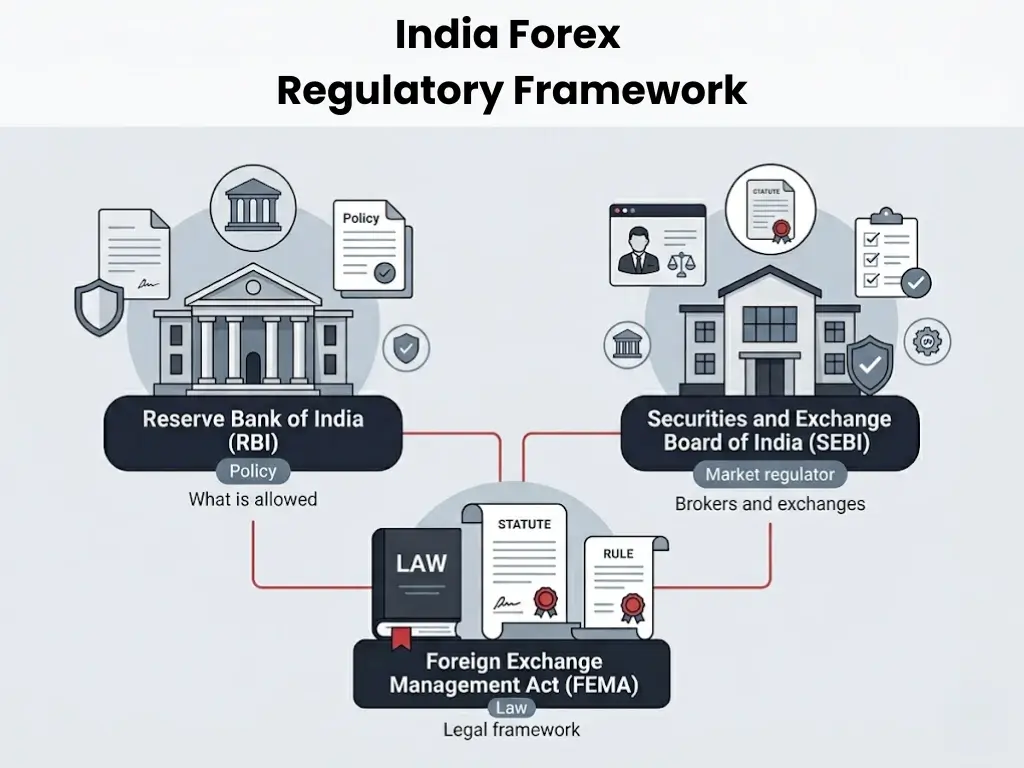
Together, these three pillars define the legal environment for every retail forex trader in India.
What Kind of Forex Trading Is Allowed in India?
India’s forex rules draw a clear line between trading that is permitted on recognised domestic exchanges and activity that falls outside the regulatory framework.
Permitted Currency Pairs
Under current RBI guidelines, Indian traders may only trade currency pairs that include the Indian rupee (INR) on one side. The pairs currently permitted on Indian exchanges are:
- USD/INR (US Dollar / Indian Rupee)
- EUR/INR (Euro / Indian Rupee)
- GBP/INR (British Pound / Indian Rupee)
- JPY/INR (Japanese Yen / Indian Rupee)
Cross-currency pairs between these currencies — such as EUR/USD, GBP/USD, and EUR/GBP — may also be traded on recognised exchanges, but only as derivatives contracts and subject to specific exchange rules.
Pairs and Platforms That Fall Outside the Rules
Trading outside the recognised Indian framework may expose residents to legal risk under FEMA. This generally includes using unauthorised international platforms or accessing products that are not permitted under the domestic exchange-based structure.
The table below summarises the main distinctions:
| Feature | Legal Trading | Illegal Trading |
| Broker Type | SEBI-registered broker | Unregistered or international broker not authorised in India |
| Currency Pairs | INR-based pairs (e.g., USD/INR) | Non-INR pairs (e.g., EUR/USD, XAU/USD) |
| Platform | NSE, BSE, or SEBI-authorised exchange | Offshore or international platform |
| Governing Body | RBI and SEBI | Outside Indian regulatory jurisdiction |
SEBI-Registered Brokers and How to Trade Legally
To trade forex legally in India, a trader must use a broker that holds a valid SEBI registration and is authorised to offer currency derivatives. These brokers route all trades through the NSE or BSE, ensuring that activity falls within the regulated framework.
When selecting a broker, Indian traders should verify the broker’s SEBI registration number, which can be checked directly on the SEBI website. Trading through an unregistered broker — even inadvertently — may expose the trader to legal risk under FEMA.
Legal forex trading in India also takes place through currency futures and options contracts listed on the exchanges, rather than through the over-the-counter (OTC) spot market structure more commonly used internationally.
This means the mechanics of trading in India differ from what traders may be accustomed to on global platforms.
Forex Trading Risks for Indian Traders
Alongside the legal framework, Indian traders should be aware of several practical risks associated with forex trading.
- Currency risk is inherent in all forex positions. Even when trading legally through an INR-based pair, movements in exchange rates can result in losses that exceed the initial margin deposited.
- Leverage risk is a significant factor in currency derivatives. While leverage can amplify potential gains, it equally amplifies losses. SEBI imposes limits on leverage available through Indian exchanges, which differs from what may be offered on international platforms.
- Regulatory risk refers to the potential for rule changes. India’s forex regulatory environment has evolved and may continue to change. Traders should monitor RBI and SEBI announcements to remain compliant.
- Platform and counterparty risk applies when using international or unregistered platforms. If a dispute arises, Indian traders may have limited legal recourse compared to using a SEBI-registered broker subject to Indian law.
For a closer look at managing exposure, leverage, and downside risk, read our guide on mastering forex risk management
Where the Legal Line Sits for Forex Trading in India
The rules around forex trading in India are narrower than many readers first assume. The recognised route sits within the framework set by the RBI, SEBI, and FEMA, which limits access to permitted products traded through recognised Indian exchanges and regulated intermediaries.
That is where the legal line becomes clear. On one side is exchange-based forex trading carried out within India’s regulated system. On the other is access through unauthorised platforms or products that fall outside that structure.
What often begins as a broad question about legality becomes much more specific once the product, platform, and regulatory route are considered together.
FAQ
Is Forex Trading Legal in India?
Yes, forex trading is legal in India but is strictly regulated. Traders must use SEBI-registered brokers and are limited to INR-based currency pairs traded on authorised exchanges such as the NSE or BSE. Trading non-INR pairs or using unauthorised international platforms is prohibited under FEMA.
Which Currency Pairs Are Legal to Trade in India?
The RBI currently permits trading in four INR-based pairs: USD/INR, EUR/INR, GBP/INR, and JPY/INR. Certain cross-currency pairs derived from these — such as EUR/USD — may also be traded as listed derivatives on Indian exchanges under specific conditions.
Is XAU/USD (Gold) Legal to Trade in India?
No. XAU/USD, which represents the price of gold against the US dollar, is not an approved currency pair under RBI guidelines. Trading this pair, or any non-INR pair, through an international platform is considered illegal under FEMA.
What Are the Penalties for Illegal Forex Trading in India?
Under FEMA, penalties for illegal forex trading can reach up to three times the amount involved in the violation. In more serious cases involving criminal intent, imprisonment may also apply under the provisions of the Prevention of Money Laundering Act (PMLA).
What Is FEMA and How Does It Apply to Forex Traders?
The Foreign Exchange Management Act (FEMA) is India’s primary law governing foreign exchange transactions. It sets out which activities are permitted for Indian residents, defines the regulatory role of the RBI, and establishes penalties for violations.
For retail traders, FEMA is the key legislation that determines whether a forex trade or platform is legal or illegal.
Can I Use an International Forex Broker in India?
Using an international forex broker to trade non-INR currency pairs is not permitted under FEMA. However, the regulatory landscape is nuanced, and what is permissible can depend on the specific products accessed and how the broker is structured. Traders should seek independent legal or financial advice before using any international platform.