
- Trading
Trading
-
CFD Trading
What is CFD Trading How to Trade CFD Why Trade CFD CFD Trading Strategies
- All Trading Products
-
Markets
All Instruments Forex CFDs Indices CFD Commodities CFD Stocks CFD ETFs CFD Bonds CFD Cryptocurrency CFDs
- Trading Accounts
- Trading Fees
- Trading Leverage
- Trading Server
- Deposit & Withdrawal
- Premium Services
-
CFD Trading
- Platforms
- Academy
- Analysis
- About
 Register
 Login
Login Register



-
AllTradingPlatformsAcademyAnalysisAbout
-
Search query too short. Please enter a full word or phrase.
-

Keywords
- Trading Accounts
- TradingView
- Trading Fees
Popular Search
- Trading Accounts
- MT4
- MT5
- Professional Trading Accounts
- Academy




What is day trading in stocks?
Day trading is a high-risk activity practiced by some traders seeking short-term market movements. However, it requires experience, significant risk management, and is not suitable for all investors. It is a short-term trading strategy centred on holding positions for short durations – ranging minutes to hours – but not overnight.
Meanwhile, stocks are shares of companies that are freely tradeable on a stock exchange during official trading hours. The prices of stocks rise and fall in response to demand from investors; they can also experience dramatic changes due to factors such as earnings reports, regulatory changes, unexpected developments or scandals.
Thus, stocks CFD day trading refers to a subset of trading where traders speculate on price movements without owning the underlying shares, buying and selling multiple times within the space of a trading day. Because a CFD day trader attempts to capitalise on short-term price fluctuations, stock CFDs with higher volatility may present more trading opportunities. Leverage increases both potential gains and losses when trading CFDs.
Once identified, such stocks can offer trading opportunities throughout the day, aligning with the needs of stock day traders. However, trading stocks carries significant risks, and profits are not guaranteed.
Do many people day trade stocks?
Many traders prefer day trading stock CFDs to capitalise on short-term price movements without owning the underlying shares. The stock market offers a wide range of stocks, giving day traders ample opportunities to apply their strategies.
Stock CFD prices fluctuate throughout the day, allowing traders to take long and short positions though profits and losses are magnified by leverage. Earnings announcements can cause sharp price changes, which some traders seek to trade on, but these events also carry significant risk.
Day trading also offers another advantage: By closing positions before the trading day ends, traders can avoid the risk of stocks gapping due to unexpected developments or news that break overnight.
5 popular stock CFD trading strategies
From large-cap blue-chip stocks, to mid-cap SMEs and small-cap startups, the stock market offers a wide array of stocks with different characteristics, opening the way for several trading strategies.
Here are five commonly used stock CFD strategies to consider when trading with leverage.
Range trading
When a stock consistently bounces between two clearly defined price levels, it is said to be trading range-bound. Such stocks are highly suitable for a range trading strategy.
The range trading strategy first looks for strongly established areas of support (an upper limit the price does not exceed) and areas of resistance (a lower limit that stock price does not go below).
Once such a range bound pattern is established over a reasonable period of time, the trader may execute range trading. This is done by buying as the price nears support, and selling as the price nears resistance.
Range trading can continue to be viable this way, until a price breakout occurs. At which point, the trader may switch to a breakout strategy, explained next.
Breakout trading
Sometimes, after trading range bound for a duration, a price breakout may occur. This usually happens when a stock has been building up momentum.
A price breakout can happen to the upside (i.e., breaking out to a higher price level) or to the downside (breaking out below a previously established price floor). Both offer trading potential for savvy traders able to anticipate them.
The idea is to anticipate a price breakout and place a trade accordingly. However, breakouts can be unpredictable, and there is no guarantee of success. Breakout trading can work because when a stock breaks above a key resistance area, there tends to be momentum for the price to ride higher. Similarly, when it breaks below a key support level, is it usual for momentum to be strong enough to drive the price lower.
Thus, traders attempting breakout trading must establish a reliable way to measure momentum and its changes in a stock they are interested in trading. This can be accomplished using the right technical indicator.
Trend trading
In breakout trading, the idea is that prices tend to continue in the direction they first take. This gives rise to another stock trading strategy, known as trend trading.
This trading strategy may seem somewhat simplistic but can be highly effective in the hands of a skilled trader. In essence, trend trading simply means “trading with the trend”. It is the basis for the popular saying “the trend is your friend, until it is not”.
To perform trend trading effectively, a trader needs to identify the prevailing price trend, and place trades accordingly. Importantly, they must also be able to identify when a price reversal is imminent and close the position in a timely manner.
In trend trading, candlestick patterns and other technical indicators should be deployed to help identify and/or confirm price trends and reversals.
Mean reversion
The mean reversion trading strategy takes advantage of a mathematical concept that stock prices tend to move back towards the middle – i.e., revert to the historical mean. This means that over time, a stock price that has moved a considerable degree from its historical average is bound to return.
Thus, a trader can potentially profit from this behaviour by placing a trade in the direction the stock price is expected to move back towards. A variation of this trading strategy is to use Fibonacci Retracements, a technical tool that plots different price levels based on the Fibonacci sequence, a naturally occurring sequence that is believed to also be found in stock prices.
Money flows
In the money flows strategy, a trader places a trade based on whether the target stock is overbought or oversold. If the stock is oversold, it may signal a buying opportunity, which the trader may take advantage of by opening a long position. If the gauge is overbought, it may signal a selling opportunity, which the trader can act upon with a short position.
The classical money flows strategy compares trading volume on a daily basis to identify overbought/oversold levels. However, this strategy can also work well with other technical indicators that also identify overbought/oversold levels, such as Relative Strength Index (RSI).
How to start day trading stock CFDs
Choose your preferred CFD day trading method
Day trading of stocks can be performed in several ways, so the first step is to choose which way you want to use.
Vantage provides access to stock CFDs for the world’s most popular stocks, such as AAPL, MSFT, NVDA and more. With stock CFDs, traders can speculate on price movements without owning the underlying shares. With our deep and wide selection of stock CFDs, traders will find ample candidates to meet their needs and execute their preferred trading strategies.
Create a day trading plan
While it may seem simple in concept, day trading can be challenging to those who do not have a disciplined approach. It is important to have a clear view of your goals and objectives, to prevent over-trading, or taking on too much risk when trading.
As such, traders should create a day trading plan. This is a record of your trading budget, strategy, position sizes, win or loss and risk management techniques. You should also include anything that helps you keep track and learn from your trading results.
Learn how to manage day trading risk
It is vital that day traders learn to keep risk under control. Day trading can be notoriously fickle, and an inexperienced trader may get frustrated and be tempted to over-trade to recover losses. Furthermore, earnings announcements, unexpected news and other geopolitical and macroeconomic events can increase volatility in stock prices, increasing the degree of unpredictability.
To keep risk in check, day traders must have a good knowledge of stock market risk factors, as well as knowing how to use risk management tools like limits and stops. A crucial part of risk management is learning how to control your risk-reward ratio. It may sound counter-intuitive, but a favourable risk-reward ratio is more impactful than a glowing win-loss ratio.
By focusing on a high risk-reward ratio above 2:1 (i.e., getting back twice the amount risked in the trade), traders can build a greater margin of protection against losing trades. This can be more helpful than a high win-loss ratio.
Open and monitor your first position
After going through the steps above, you are ready to start day trading stock CFDs. You can go ahead and place your first position, after considering carefully which stock to trade, the strategy you will employ, how large your position will be, and your take-profit and stop-loss levels.
In general, you’ll buy or go long if you think the stock will go up, and sell or go short if you think the stock will fall. Remember to monitor your position as the trade plays out, including scanning for news or developments that could impact your trade. This becomes increasingly important as you begin to make several trades throughout the day, as is expected of day traders.
As the trading day draws to a close, remember to close any open positions. This is to avoid overnight risk, where stock prices can spike or plunge outside of market hours due to unexpected news or developments.
EXPLORE MORE ABOUT STOCK TRADING
-

WHAT ARE STOCKS CFDs
Learn the fundamentals of stocks and how they work.
-
WHY TRADE STOCKS CFDs
Find out the unique benefits and advantages that trading stocks can offer, and why the stock market has such enduring appeal among the investing community.
-
How to Trade Stocks CFDs
Learn how to open a trade, set stop-losses, and manage risk.



Award-Winning Broker
-

Best Broker
AustraliaInternational Business Magazine
-
Best Customer
Support AustraliaInternational Business Magazine
-
Best Overall Broker –
AustraliaInternational Business Magazine

Trade AU Share CFDs On All Trading Platforms

MetaTrader4
- 30 built-in technical indicators
- 31 analytical charting tools
- 9 time-frames
- 4 types of trading orders

MetaTrader5
- 38 built-in technical indicators
- 44 analytical charting tools
- 21 time-frames
- 6 types of trading orders

TradingView
- 15+ chart types
- 100+ in-built indicators
- 50+ drawing tools
- 12 alert conditions

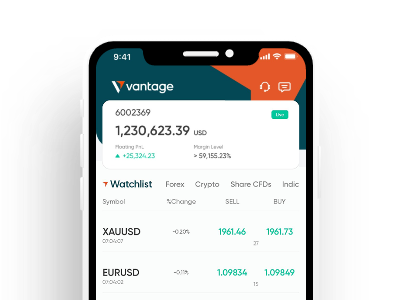
Vantage Mobile App
- 55 deposit methods globally
- 220+ daily product analysis
- 16 TradingView indicators
- 80,000+ copy traders
Choose a Trading Account Based on Your Experience Level
-
1
Beginner Traders
-
2
Experienced Traders
-
3
Professional Traders

High Volume Traders
- For traders looking for low and competitve commission, with only $1 per standard FX lot per side.




-
1
Register
Quick and easy account opening process.
-
2
Fund
Fund your trading account with an extensive choice of deposit methods.
-
3
Trade
Trade with spreads starting as low as 0.0 and gain access to over 1,000+ CFD products.
Frequently Asked Questions
-
1
Can I trade stock CFDs with $100?
Yes, you can trade stock CFDs with $100, but it depends on the broker you choose, your trading strategy, and the leverage available. Leverage allows you to control a larger position with a smaller amount of capital, amplifying both potential gains and losses. While leverage can increase your trading power, it also raises the risk of losing more than your initial investment. -
2
Is stock CFD trading a good idea?
Stock CFD trading is a high-risk activity that requires a strong understanding of market fundamentals. It may not be suitable for all investors. Many brokers, like Vantage, offer educational resources such as courses and webinars to help new traders get started. You can start with a small amount of capital and gradually build your skills as you gain experience. It's important to start small, practise, and conduct thorough research before trading. -
3
What is stock trading through CFD and how does it work?
Stock trading through CFDs allows traders to speculate on price movements without owning the underlying shares. This carries both potential opportunities and significant risks, including the possibility of losing more than the initial investment. With Vantage, traders can access stock CFDs (Contracts for Difference), allowing them to speculate on rising or falling prices without owning the underlying asset. This gives traders the flexibility to trade both long and short positions with access to real-time data and advanced trading tools. -
4
How much money do I need to start trading stock CFDs?
With a Vantage live account, you can start trading stock CFDs with a minimum deposit of USD $50. The actual amount needed will depend on factors like the type of stocks, the leverage used, and your personal risk tolerance. -
5
Can I teach myself how to trade stock CFDs?
Yes, you can teach yourself how to trade stock CFDs by using educational resources like articles, webinars, and tutorials. Vantage offers a range of learning materials to help you understand market fundamentals, technical analysis, and trading strategies. Practising with a demo account can also help you gain experience before trading with real capital.
Disclaimer: The information is provided for educational purposes only and doesn't take into account your personal objectives, financial circumstances, or needs. It does not constitute investment advice. We encourage you to seek independent advice if necessary. The information has not been prepared in accordance with legal requirements designed to promote the independence of investment research. No representation or warranty is given as to the accuracy or completeness of any information contained within. This material may contain historical or past performance figures and should not be relied on. Furthermore estimates, forward-looking statements, and forecasts cannot be guaranteed. The information on this site and the products and services offered are not intended for distribution to any person in any country or jurisdiction where such distribution or use would be contrary to local law or regulation.